Imagine walking into a massive industrial warehouse. You’re not lost because you can’t see the shelves — you’re lost because there’s no logic to where anything is. A ball bearing could be next to a hydraulic pump, and a safety harness could be sitting in the same bin as a welding torch.
Now imagine the same space, but every object lives in a perfectly thought-out structure: categories within categories, each level revealing more detail, guiding you effortlessly from the general to the precise. That invisible map — the thing that makes finding, using, and managing all that information possible — is taxonomy.
In the digital and operational side of MRO, taxonomy is not just a nice-to-have. It’s the data architecture that underpins search accuracy, cataloguing efficiency, and even procurement intelligence. It’s the quiet logic behind why a maintenance technician can find the exact gasket in seconds, or why procurement can analyze spending by category without combing through hundreds of irrelevant entries.

The Core of Taxonomy: More Than Just Categories
At first glance, taxonomy might look like “just a list of categories,” but in an industrial context, it’s a hierarchical intelligence system.
- At the top level – Broad divisions like Mechanical, Electrical, Safety Equipment.
- Mid-levels – Subcategories breaking down those divisions, e.g., Mechanical → Bearings → Roller Bearings.
- Lowest levels – Highly specific classification, often tied directly to a material code or drawing.
The key is hierarchy — each level is nested within a broader one, creating a consistent logic from top to bottom.
Why Taxonomy is Critical in MRO Operations
Here’s where taxonomy becomes more than a data exercise — it becomes an operational asset:
- Accelerated Search and Retrieval
Maintenance staff can drill down logically instead of relying on keyword guessing. - Error Prevention in Procurement
Proper taxonomy prevents buying the wrong item simply because it shared a partial description. - Standardization Across Departments
Everyone speaks the same classification language, from engineering to supply chain. - Analytical Power
Spending, stock levels, and usage patterns can be measured at any category level.
Taxonomy vs. Other Classification Systems
In MRO data governance, taxonomy is often confused with related concepts:
- Product Hierarchy – A taxonomy is broader; it can classify not only products but also documents, assets, suppliers, and spare parts.
- Attribute Lists – Attributes describe details within a category; taxonomy determines which category an item belongs to.
- Material Groups – A subset of taxonomy, often focused on procurement.
Functional Lens Example:
A welding helmet might sit under:
Taxonomy → Safety Equipment → Personal Protective Equipment → Eye and Face Protection → Welding Helmets
But within that, attributes could be “Lens Shade 11,” “Auto-Darkening,” “Polycarbonate Lens.”

Embedding Taxonomy into the Fabric of Industrial Systems
Taxonomy comes alive when integrated into digital ecosystems:
- ERP Systems – Structured category codes for procurement and stock reports.
- EAM Systems – Asset-related components classified for maintenance planning.
- Document Management Systems – Technical manuals classified for quick retrieval.
In action:
A procurement officer filters an SAP report not just for “filters” but specifically for Fluid Handling → Filtration → Hydraulic Filters, instantly isolating relevant spend data.
Designing an Effective Industrial Taxonomy
A strong taxonomy has qualities that make it sustainable:
- Logical Consistency – Every category follows the same structural rules.
- Balanced Depth – Enough levels for precision without overwhelming users.
- Scalability – Able to handle new technologies and products without breaking.
- Cross-Functional Relevance – Works for engineering, procurement, and maintenance alike.
Mistakes That Break a Taxonomy
- Mixing Categories and Attributes – “Stainless Steel” belongs as an attribute, not a category.
- Redundant Categories – Two categories with the same meaning split relevant items.
- Uncontrolled Growth – Adding new categories without governance creates chaos.
- Ignoring Standards – Disregarding frameworks like UNSPSC or eCl@ss limits interoperability.
Functional Use Cases Across the Industrial Landscape
Use Case 1 – Fast Maintenance Response
A turbine goes down. The technician filters the spare parts catalog through:
Mechanical Components → Rotating Equipment → Turbines → Gas Turbines → Compressor Section
Instead of searching thousands of items, they arrive at the right part family in seconds.
Use Case 2 – Procurement Spend Optimization
By analyzing spend data at the category Electrical Components → Motors → Induction Motors, the procurement team negotiates better terms with a preferred supplier.
Use Case 3 – Safety Compliance
Taxonomy enables quick audits: filtering all Safety Equipment → PPE → Fall Protection items to verify they meet updated regulatory standards.
Taxonomy as the Backbone of Data Discipline
When taxonomy is neglected, data becomes messy, searches fail, and operational decisions slow down. When it’s respected, taxonomy becomes an invisible enabler — making processes faster, safer, and more accurate.
And while designing a taxonomy from scratch can be daunting, it’s one of the most valuable steps an organization can take toward true data intelligence.
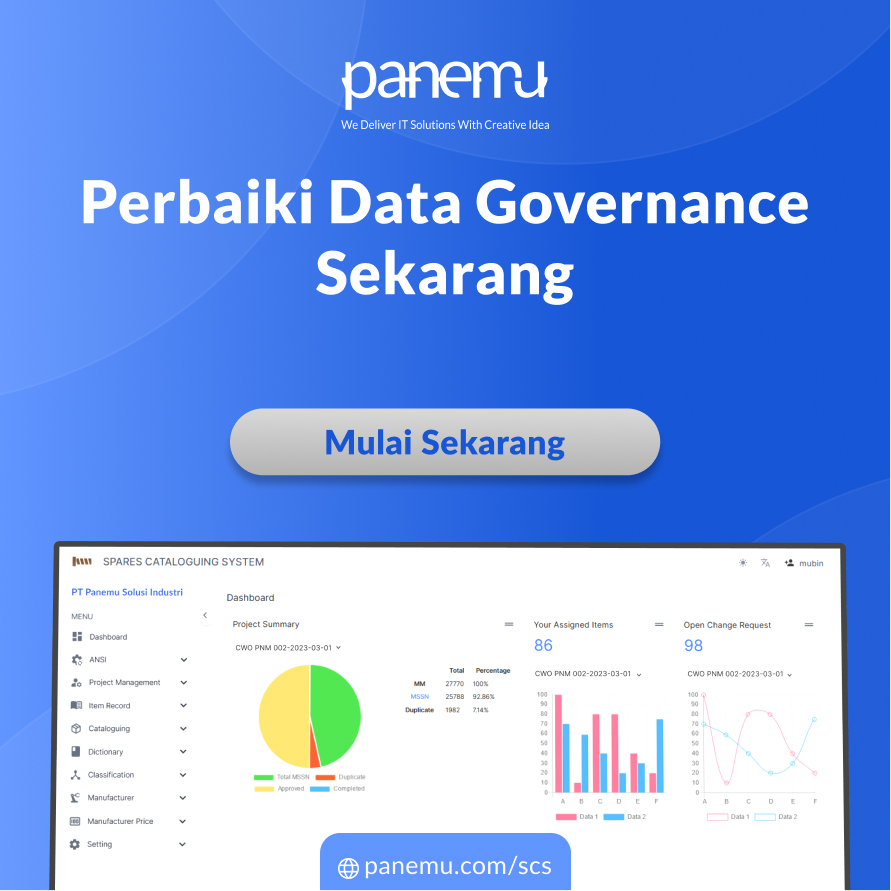
For teams that want a taxonomy built to endure — one that integrates seamlessly into cataloguing, procurement, and maintenance systems — Panemu’s Cataloguing Service delivers the structure and governance to make it work. And for managing that taxonomy at scale, SCS Key Feature provides the platform to keep your categories consistent, traceable, and ready for whatever the operation demands.