In asset-intensive operations, material master data is not a passive database. It drives maintenance execution, procurement strategy, inventory valuation, and uptime reliability. When multiple sites operate with different standards, systems, and description logic, consolidation becomes technically and operationally complex.
The challenge is not merely combining files. It is reconciling different languages that describe the same physical reality.
Consider a single industrial bearing used across several facilities:
- Site A records it as:
“BRG 6310 ZZ SKF” - Site B records:
“Bearing Ball 6310 Double Shield” - Site C records:
“Bearing – 50mm ID – Shielded”
Three entries. Potentially three stock codes. Possibly three suppliers. Maybe three safety stock calculations.
Technically, they represent the same function. Systemically, they are fragmented assets.
Now multiply that scenario across tens of thousands of MRO items per site. Multiply again across multiple operating locations. The scale of inconsistency becomes exponential.
Research from Gartner consistently shows that poor data quality generates substantial financial losses annually due to inefficiencies, excess inventory, and decision errors. In asset-heavy environments, the cost is amplified because material data directly impacts uptime and working capital.
When data lacks structure, visibility becomes an illusion.
The Technical Barriers to Consolidation
From an operational perspective, multi-site material data consolidation introduces layered challenges that go far beyond data merging.
1. Non-Standardized Naming Conventions
Many legacy databases rely on free-text descriptions. While convenient during item creation, free-text entries are destructive to enterprise analytics.
Without structured naming:
- Duplicate detection becomes unreliable
- Spend analysis becomes distorted
- Interchangeability identification becomes manual
- Stock optimization becomes reactive
Free-text is flexible. Structure is scalable.
Enterprise environments require scalability.
2. Duplicate and Functional Duplicate Materials
Duplicates are not always identical entries. They are often functional duplicates—items serving the same technical purpose but registered differently due to variations in wording, units, or manufacturer references.
Examples of typical duplication triggers:
- Inconsistent abbreviations
- Brand-first vs. specification-first descriptions
- Missing dimensional attributes
- Different unit-of-measure entries
- Emergency purchases created outside standard workflow
When duplicates spread across sites, inventory value inflates quietly. Procurement volumes fragment. Excess stock hides in plain sight.
And financial reporting reflects numbers that look accurate—but are operationally misleading.
3. Unit-of-Measure (UoM) Inconsistencies
One site stores cable in meters. Another in rolls. Another in feet.
One site purchases lubricants in drums. Another records them in liters.
Without UoM harmonization, cross-site comparison becomes unreliable. Automated replenishment logic weakens. Enterprise dashboards lose credibility.
Consolidation demands normalization—not approximation.
4. ERP and Legacy System Diversity
Multi-site enterprises often operate hybrid ERP landscapes:
- SAP in one region
- Oracle in another
- Legacy systems in older facilities
Field structures differ. Attribute constraints differ. Mandatory fields differ. Classification capabilities differ.
Data mapping alone does not solve structural misalignment. It only transfers inconsistency into a new container.
5. Absence of Data Governance
Even after cleansing initiatives, without governance:
- New duplicates emerge
- Standards degrade
- Description quality declines
- Emergency item creation bypasses validation
Consolidation is not a one-time project. It is a discipline.
The Operational Consequences That Accumulate Over Time
Material data fragmentation does not create dramatic headlines. It creates silent inefficiencies:
- Maintenance planners cannot quickly confirm part interchangeability.
- Procurement cannot leverage enterprise-wide volume contracts.
- Inventory rebalancing between sites becomes manual and slow.
- Working capital remains unnecessarily high.
- Engineering standardization becomes difficult to enforce.
These inefficiencies accumulate. They compound.
When one site overstocks a pump kit while another urgently purchases the same kit at premium freight cost, the organization absorbs unnecessary expense. When identical spare parts are coded differently, analytical reporting misrepresents demand patterns.
The system appears functional.
But it is not optimized.
Why Conventional Consolidation Efforts Stall
Many enterprises initiate consolidation through ERP harmonization or mass data migration. Yet the outcome often delivers partial improvement rather than structural transformation.
The reason is simple:
Data is transferred without being engineered.
Effective consolidation requires more than cleansing. It requires structured cataloguing logic, attribute discipline, and enterprise-wide classification standards.
Without a structured foundation, normalization efforts remain cosmetic.
Material Cataloguing as the Structural Backbone
Material cataloguing introduces engineering discipline into master data.
A structured cataloguing system typically incorporates:
- Hierarchical class and subclass taxonomy
- Defined attribute templates per material category
- Standardized abbreviations and description sequencing
- Technical parameter validation
- Manufacturer and part number normalization
- Duplicate prevention rules
This transforms descriptions from narrative text into structured technical identifiers.
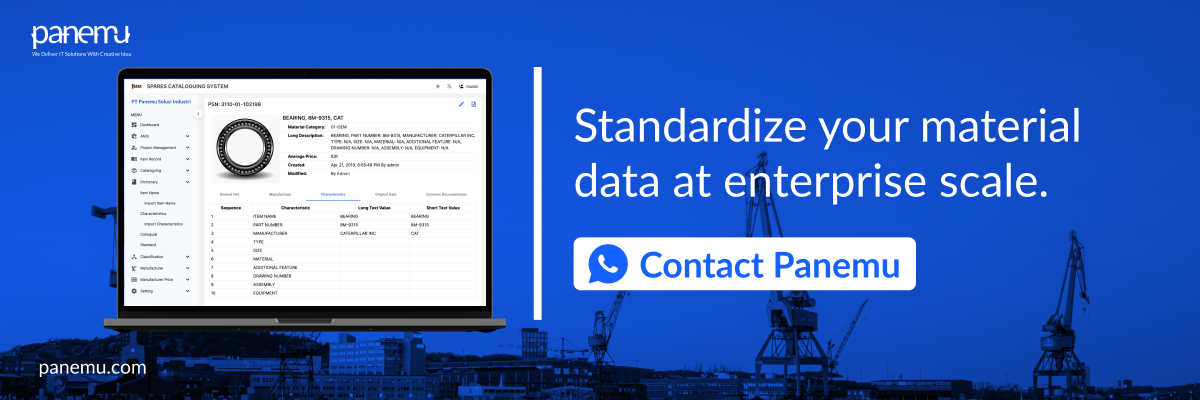
Frameworks such as the Spares Cataloguing System® (SCS®), developed by Panemu, are designed specifically for asset-intensive operations where accuracy directly affects uptime. SCS® applies attribute-driven methodology and functional identification principles to prevent duplication and enforce standardization across sites.
The objective is not simply clean data. It is sustainable clarity.
Structured Phases of Multi-Site Consolidation
Successful consolidation initiatives typically follow disciplined stages:
Phase | Focus | Outcome |
Baseline Assessment | Duplicate ratio, attribute completeness, taxonomy gaps | Visibility of current condition |
Enterprise Standard Design | Taxonomy, abbreviation dictionary, attribute schema | Unified structural framework |
Data Cleansing & Normalization | Duplicate merging, UoM alignment, description restructuring | Harmonized legacy data |
Cross-Site Rationalization | Code consolidation, stock aggregation review | Enterprise-level visibility |
Governance Implementation | Workflow control, approval hierarchy, audit mechanisms | Long-term integrity |
Notice the sequence: structure first, cleansing second, governance continuous.
Without governance, entropy returns.
Financial and Strategic Impact
Clean, consolidated material master data unlocks measurable leverage:
- Reduction in MRO inventory through duplicate elimination
- Improved service level without increasing stock
- Better demand forecasting accuracy
- Stronger enterprise-level supplier negotiations
- Lower obsolescence risk
In large-scale operations, even single-digit percentage reductions in MRO inventory translate into significant working capital release.
But beyond financial metrics lies strategic enablement.
Reliable master data supports:
- Predictive maintenance integration
- Critical spare analysis
- Enterprise asset management optimization
- Digital transformation initiatives
Digital transformation built on fragmented data is fragile. Built on structured data, it is scalable.
The Operational Insight Often Overlooked
Those closest to the process often understand the problem most clearly. They see repetitive item creation. They struggle with unclear specifications. They work around incomplete records to meet operational deadlines.
Their experience reveals something important:
Material data fragmentation is not theoretical. It is operational friction.
And friction slows performance.
When that friction is removed—when searching becomes precise, when duplication disappears, when cross-site visibility becomes real—the operational rhythm changes.
Clarity accelerates execution.
Technology Is an Enabler, Not the Foundation
Advanced ERP systems, AI-based duplicate detection, and data migration tools are powerful accelerators. But they cannot replace structured logic.
Consolidation requires alignment of:
- Structured cataloguing methodology
- Governance framework
- Organizational commitment
Remove one element, and improvement becomes temporary.
Sustainable consolidation demands structural integrity.
The Strategic Reflection
As operations expand across multiple sites, complexity grows naturally. Acquisitions add diversity. Legacy systems persist. Local habits remain embedded.
The question is not whether fragmentation exists.
The question is whether it is being addressed structurally—or tolerated quietly.
Material master data is not a background administrative function. It is operational infrastructure. It determines how efficiently capital is deployed, how reliably maintenance executes, and how confidently leadership makes decisions.
When multi-site data is fragmented, enterprise visibility becomes fragmented.
When it is structured, standardized, and governed, decision-making sharpens.
Working capital frees.
Procurement strengthens.
Operations stabilize.
Multi-site consolidation is not about merging databases.
It is about engineering consistency into complexity.
It is about transforming scattered material records into enterprise intelligence.
And it is about building a foundation strong enough to support the next phase of operational growth.
If operational clarity, inventory optimization, and enterprise-wide standardization are priorities, then material data consolidation cannot remain a deferred initiative.
Initiate a focused executive discussion. Evaluate the structural integrity of your material master. Explore structured cataloguing frameworks such as Spares Cataloguing System® (SCS®).
Because when material data becomes clear, decisions become confident.
Schedule a Strategic Consultation Today. Unlock operational visibility across every site—and convert data complexity into enterprise control.