Procurement decisions are rarely made in isolation. Every purchase order reflects a chain of assumptions: that the material specification is correct, that the vendor is suitable, that pricing is comparable, and that the risk is understood. When these assumptions are valid, procurement becomes a controlled and transparent process. When they are not, procurement turns reactive, fragmented, and costly.
At the center of this dynamic lies a fundamental dependency: the synchronization between vendor data and material data.
In many organizations, vendor master and material master exist in the same ERP system, yet operate as separate worlds. Materials are created without clear vendor linkage. Vendors are approved without standardized material references. As a result, procurement teams work harder than necessary to achieve outcomes that should be systematic.
This article explores why synchronizing vendor and material data is essential for efficient procurement, how data misalignment undermines transparency, and why Management Master Data is the foundation of an integrated procurement ecosystem.

Procurement Complexity Is Often a Data Integration Problem
Procurement complexity is commonly attributed to market volatility, supplier constraints, or internal approval layers. While these factors matter, they often obscure a deeper issue.
Procurement becomes complex when information is fragmented.
When vendor data and material data are not consistently linked, every procurement cycle requires interpretation. Buyers must manually verify which vendor supplies which material. Engineers must confirm technical equivalence. Planners must reconcile pricing histories across inconsistent references.
Is the organization managing procurement, or is it constantly validating its own data?
This distinction matters. One creates efficiency. The other creates dependency on individual effort.
Vendor Data and Material Data Serve Different Purposes, but One Outcome
Vendor master data answers questions about who supplies. Material master data answers questions about what is supplied. Procurement requires both answers simultaneously.
When these datasets are not synchronized, gaps emerge.
A material may exist in the system without a clear list of approved vendors. A vendor may be active without a standardized list of materials they are qualified to supply. Pricing conditions may exist without consistent material references. Historical spend may be recorded but not easily analyzed.
The ERP contains the data, but the relationship between data is weak.
Without structured linkage, procurement transparency becomes conditional. It depends on manual checks rather than systemic clarity.
The Hidden Cost of Unlinked Vendor–Material Relationships
The impact of unsynchronized data is rarely captured in a single metric. Instead, it manifests across daily operations.
Buyers spend more time searching for correct vendor options. Engineers are pulled into procurement discussions to confirm technical suitability. Procurement cycles extend because approvals require additional justification. Emergency purchases bypass preferred vendor strategies.
Each step adds friction.
Over time, this friction accumulates into higher transaction costs, inconsistent pricing, and reduced leverage. More importantly, it introduces risk. Decisions are made with partial information. Exceptions become routine.
Is procurement truly strategic when it is constantly reacting to data uncertainty?
Transparency Begins with Structured Relationships
Procurement transparency is not achieved through reporting alone. It begins with structured relationships at the master data level.
When materials are standardized and linked to qualified vendors, visibility improves immediately. Buyers can see approved options without guesswork. Pricing comparisons become meaningful because materials are consistently defined. Compliance is easier to enforce because exceptions are visible.
Transparency reduces negotiation noise. It allows procurement teams to focus on value rather than validation.
This transparency is not about control for its own sake. It is about clarity.
Management Master Data as the Integrator
Management Master Data provides the framework to integrate vendor and material information logically and consistently.
From a technical perspective, synchronization typically involves:
- Standardized material definitions that enable vendor comparison
- Vendor records enriched with scope of supply and qualification context
- Structured links between materials and approved vendors
- Alignment of manufacturer data with vendor offerings
- Governance rules for maintaining these relationships over time
When these elements are present, procurement data becomes relational rather than transactional.
Relational data supports insight. Transactional data alone supports execution.
Pricing, Spend, and the Illusion of Control
Many organizations believe they have visibility into procurement spend because reports exist. In practice, spend visibility is often distorted by inconsistent material and vendor references.
The same material may be purchased under different descriptions. The same vendor may appear under slightly different names. Manufacturer references may be missing or inconsistent. As a result, spend analysis becomes approximate.
This creates an illusion of control.
Procurement teams may believe they are consolidating spend, while in reality, fragmentation persists beneath the surface. Negotiation strategies are weakened because volumes are understated. Supplier performance analysis is skewed because data is scattered.
True spend transparency requires synchronized master data. Without it, procurement operates with blind spots.
Reducing Dependency on Individual Knowledge
In many organizations, effective procurement relies heavily on experienced individuals. They know which vendor can supply which material. They understand historical substitutions. They remember past issues.
This knowledge is valuable, but fragile.
When procurement depends on personal memory rather than system intelligence, scalability suffers. New team members struggle. Cross-site consistency declines. Knowledge becomes a bottleneck.
Synchronizing vendor and material data embeds knowledge into the system. It reduces dependency on individuals and increases organizational resilience.
Systems should remember so people can decide.
Multi-Site Procurement Amplifies the Need for Synchronization
In distributed operations, procurement complexity increases exponentially.
Different sites may use the same vendor for different materials, or different vendors for equivalent materials. Without standardized material definitions and vendor linkage, consolidation opportunities are missed.
Central procurement initiatives struggle because equivalence cannot be proven quickly. Local exceptions multiply because global data lacks credibility.
Can procurement be centralized effectively without a unified data foundation? Can supplier strategies succeed when material definitions vary by location?
Synchronization creates a common reference point. It enables global strategies while respecting local execution.
Operational Risk Hides in Data Gaps
Procurement decisions carry operational consequences.
Incorrect vendor selection can lead to quality issues. Delayed procurement can extend downtime. Emergency sourcing can increase safety risk.
When vendor–material relationships are unclear, these risks increase. Decisions are made under pressure with incomplete information. The safer option often becomes bypassing process.
Fear does not arise from process. It arises from uncertainty.
Clear, synchronized data reduces uncertainty. It supports confident decisions even under pressure.
Integration Does Not Mean Complexity
Data integration is often perceived as complex and disruptive. In reality, effective synchronization simplifies operations.
The goal is not to create rigid systems, but to create clear relationships. Material definitions should be precise enough to enable comparison. Vendor data should be rich enough to support selection. Governance should guide behavior without slowing it.
This balance requires design, not improvisation.
Over-engineered solutions fail because they are not used. Under-engineered solutions fail because they do not solve the problem. Practical integration sits between these extremes.

Cataloguing Service as the Enabler of Procurement Integration
A structured Cataloguing Service plays a critical role in synchronizing vendor and material data.
By standardizing material master data first, cataloguing creates a stable reference for vendor linkage. Materials are defined consistently. Attributes support differentiation. Manufacturer references are normalized.
Once this foundation exists, vendor data can be linked accurately. Approved vendor lists become meaningful. Pricing conditions align with standardized materials. Procurement workflows become clearer.
Cataloguing is not a procurement function. It is a procurement enabler.
From Fragmented Transactions to Integrated Decisions
When vendor and material data are synchronized, procurement behavior changes.
Buyers select vendors with confidence. Engineers trust material equivalence. Planners rely on lead time data. Management sees consolidated spend.
Procurement shifts from transactional execution to integrated decision-making.
This shift does not require new ERP systems. It requires better use of existing ones through strong Management Master Data.
The Emotional Dimension of Procurement Efficiency
Procurement professionals operate under constant pressure. Cost targets, delivery timelines, compliance requirements, and operational urgency intersect daily.
When data is unclear, pressure increases. When data is clear, pressure becomes manageable.
Clarity reduces stress. It enables focus. It supports accountability.
Efficient procurement is not only about saving money. It is about reducing friction in decision-making.
A Structured Path Forward
If procurement processes rely heavily on manual validation, if spend visibility feels approximate, or if vendor selection often depends on personal knowledge, the issue is not effort. It is integration.
Start with the data relationships that matter most.
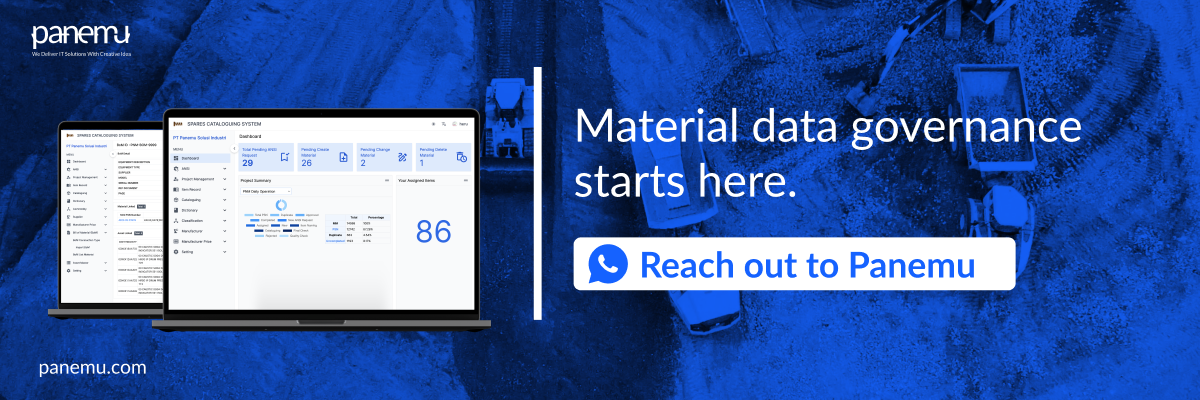
Spares Cataloguing System® (SCS®) provides a structured, standards-based approach to material master standardization and governance, creating a reliable foundation for synchronizing vendor and material data. By enabling consistent definitions and controlled relationships, SCS® supports transparent, efficient, and scalable procurement processes.
Explore how SCS® works at panemu.com/scs and review its key features at panemu.com/scs-key-feature.
Build procurement transparency on data you can trust. Integrate vendor and material information, and let your systems support the decisions they were meant to enable.