You've just closed out a six-figure ERP data cleansing project. The steering committee is thrilled. Duplicate rates have collapsed to near zero, and your dashboards finally show a database you can be proud of. But somewhere beneath the relief, you already suspect the truth: this clean state has an expiration date. Because tomorrow morning, the first unvetted material request lands in the queue—and the decay begins again, one keystroke at a time.
Clean Data Does Not Stay Clean
How long does a "perfectly clean" Enterprise Resource Planning (ERP) database actually stay clean? The honest answer is: not for long. Many organizations invest heavily in massive, resource-intensive data cleansing or cataloguing projects. They align formats, deduplicate parts by the thousands, and hand back a clean, structured baseline to the business.
Yet without a governance framework wrapped around that baseline, data quality degrades significantly within 12 to 24 months. This is not a hypothetical risk. It is the default outcome for any Material Master Data set left ungoverned after a cleanup, and it is consistent enough across asset-intensive industries—mining, oil and gas, manufacturing, utilities—that it deserves to be treated as a law of ERP physics rather than a case of bad luck.
The uncomfortable part is that this decay happens quietly. No single transaction looks dangerous. No single technician is doing anything wrong. But the cumulative effect, multiplied across thousands of Create, Change, and Delete requests a year, rebuilds the exact mess the cleansing project was hired to remove.
The Hidden Mechanics of Daily Data Decay
The cause of this rapid degradation is rarely a flaw in the initial cataloguing standard. It is the natural consequence of daily business operations. Every working day, an active industrial site is in a state of constant motion. New parts are registered, existing descriptions are edited to match supplier updates, and outdated records are retired.
Under pressure to keep machines running, warehouse planners and SCM teams submit requests rapidly, often under time constraints that leave little room for careful classification. Without continuous, active governance at the point of intake, small variations and duplicate items inevitably creep back into the system.
Consider a simple bearing. A technician might request it under its manufacturer part number. A colleague at another site registers the functionally identical item under a plain-language description. A third enters it by drawing number, because that is what the original requisition happened to reference. Three requests, one physical part, and—absent a screening layer—three separate material codes.
Over time, these minor inconsistencies accumulate into a silent backlog: duplicated inventory, inconsistent units of measure, fragmented spend data, and classification codes that no longer map cleanly to UNSPSC, eCl@ss, or NATO/NSN taxonomies. None of it looks urgent on any single day. All of it compounds.
Why Internal Teams Struggle to Maintain Standards
When data quality suffers, leadership often attributes it to a lack of effort or discipline from internal SCM teams. This is a fundamental misdiagnosis, and a costly one, because it usually leads to more training and more policy documents rather than a structural fix.
Supply chains are constantly changing, and so is the technical data supporting them. Internal SCM and maintenance personnel are primarily focused on keeping operations moving, reducing unplanned downtime, and managing immediate logistical pressure. Cataloguing discipline is rarely their core KPI, and it shows in how requests get filled out under deadline.
Cataloguing is also a highly specialized skill in its own right. It requires deep familiarity with industrial standards such as UNSPSC, eCl@ss, NATO/NSN, or MESC, along with fluency in technical dictionaries and manufacturer nomenclature. Expecting warehouse workers or procurement officers to execute precise cataloguing on top of their operational responsibilities introduces a high risk of interpretation drift.
Standards drift naturally when different individuals, at different sites, in different shifts, interpret naming conventions and attribute rules in isolation. Without a single point of enforcement, "standardized" quietly becomes "standardized, mostly, depending on who typed it in."

The Real Cost of Silent Decay
The financial exposure here is easy to underestimate precisely because it is distributed. A duplicate material record does not show up as a single line-item loss. It shows up as a slow leak across procurement, warehousing, and maintenance simultaneously.
Every duplicate part number represents inventory that is technically redundant but administratively invisible—stock that sits in two bins under two codes, quietly inflating carrying costs and tying up working capital that should be funding other priorities. Purchasing teams, unaware that an equivalent item already exists in the system, source and negotiate as if from a blank slate, forfeiting the leverage of consolidated spend.
Maintenance and reliability teams pay a different price. When a technician searches for a "critical spare" and the system shows zero stock—because the actual inventory sits under a differently worded duplicate—the result can be an emergency purchase, an expedited freight charge, or in the worst case, extended unplanned downtime while the correct part is located or reordered. Industrial downtime costs, well documented across manufacturing and process industries, routinely run into the tens of thousands of dollars per hour for critical assets. A five-minute data search failure can trigger a multi-hour production loss.
None of these costs appear on a "data quality" line in the P&L. They are absorbed into procurement variance, inventory carrying cost, and maintenance overtime—which is exactly why the decay is so easy to ignore until it becomes structural.
Signs Your ERP Is Already Sliding Back
Decay rarely announces itself with a dramatic failure. It shows up as a pattern of small, deniable frictions that data owners learn to work around instead of fixing. Watch for these signals in the months following any cleansing project:
• Search results multiplying. A single part number search that once returned one clean hit now returns two or three near-identical descriptions.
• Rising "not found, reorder" tickets. Planners increasingly report that a part "must be out of stock" when it is actually sitting under an alternate code.
• Attribute fields going blank again. New records are created with incomplete technical specifications because the person entering them lacks the reference drawing or manufacturer catalogue at hand.
• Classification codes drifting. New items are tagged inconsistently against UNSPSC or eCl@ss because no single team owns the taxonomy day to day.
• Growing "pending review" queues. Requests pile up because nobody has clear authority—or time—to validate them against the standard.
Any one of these on its own looks minor. Seen together, across a full fiscal year, they are the early architecture of the exact database your cleansing project just spent months dismantling.
From Periodic Cleanups to a Daily Operating Standard
If periodic cleanups only treat the symptoms of data decay, the real fix is to stop treating governance as a project at all. Material Master Data governance must be institutionalized as a continuous, daily operational standard, not scheduled as a recurring fire drill every three to five years.
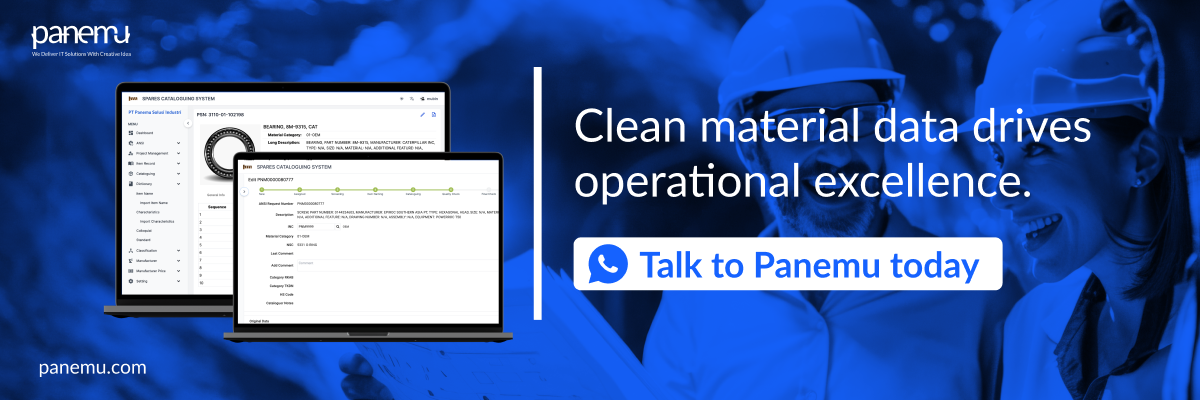
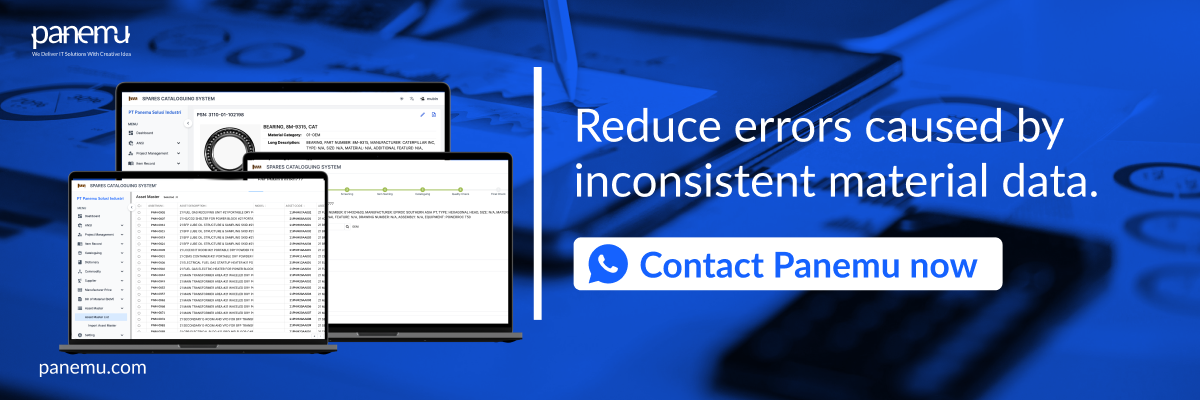
This is the exact philosophy behind PT Panemu Solusi Industri's Daily Cataloguing Service, delivered through the SCS®-ANSI governance module. Instead of reacting to a bloated, duplicate-ridden ERP system after years of operational friction, organizations can govern every Create, Change, and Delete request in real time, at the moment it is submitted.
By partnering with Panemu, enterprises secure a dedicated team of experienced cataloguing specialists supported by a structured governance platform. Daily cataloguing ensures that every material record is standard-compliant, screened for duplicates, and properly enriched before it is ever posted to the ERP—not months or years after the fact.
What Daily Governance Looks Like in Practice
In practical terms, daily governance means every new request passes through the same disciplined checkpoints, regardless of who submitted it or which site it came from. Structured intake replaces free-text guesswork. Duplicate screening happens before a new code is created, not after. Cataloguing specialists—not warehouse staff under deadline pressure—construct the standardized description and attribute set.
This is what separates a governed database from a merely clean one. A clean database is a snapshot. A governed database is a discipline, sustained transaction by transaction, so the baseline your cleansing project delivered is the baseline your organization still has two years from now.
Just as importantly, every decision in that daily workflow leaves a record. Who requested the item, who catalogued it, who approved it, and when it was posted—all captured automatically, without asking anyone to fill out an extra form. That audit trail matters when finance asks why inventory carrying cost moved, when an auditor asks how a duplicate slipped through, or when a new plant manager asks whether the master data they inherited can actually be trusted.
Rethinking the Business Case for "After the Project"
Most ERP and digital transformation budgets are built around the project itself: the migration, the go-live, the cutover weekend. Governance rarely gets its own line item, because it is easy to assume that a clean go-live state is a permanent state. It never is.
The organizations that protect their cleansing investment longest are the ones that budget for governance the same way they budget for cybersecurity or equipment maintenance—not as a one-time cost, but as a standing operational function. Framed that way, daily cataloguing is not an added expense on top of your ERP program. It is the maintenance plan that keeps the original investment from silently eroding, quarter after quarter, until someone has to pay for the exact same cleansing project all over again.
**Transform Your Data Quality Today**
Stop watching your ERP data quality degrade. PT Panemu Solusi Industri offers a Complimentary Master Data Assessment and Free Consultation to help you design a sustainable daily governance framework.
Contact our team at [email protected] or reach out via WhatsApp at +62 812-1590-2011 to secure your ERP investment and streamline your operations. Learn more at panemu.com/scs.