How many times has your maintenance team ordered a "critical spare" that was actually sitting under a misspelled name in a different warehouse? If you can't answer that with confidence, your ERP already has a duplicate problem—you just haven't found it yet.
The Moment the Damage Is Already Done
In asset-intensive industries, once a duplicate material record enters an ERP system, the damage is already done. Purchasing departments buy the same item from different suppliers at varying prices, unaware that a functionally identical part already exists three codes away. Warehouses overstock redundant parts, tying up valuable working capital in inventory that should never have been created.
Planners spend hours searching for critical spares that appear to be out of stock, only to discover they were registered under an alternative name, a different unit of measure, or a manufacturer part number nobody cross-referenced. To build a truly efficient supply chain, duplicates must be stopped at the gate—before they ever enter your ERP, not cleaned up after they have already cost you money.
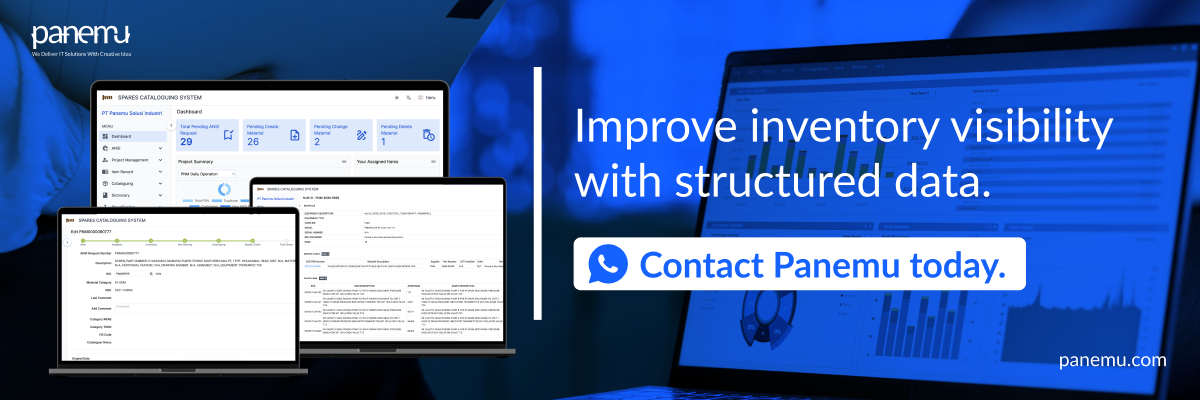
The Vulnerability of Uncontrolled Intake
Most ERP and CMMS platforms—SAP, IBM Maximo, Oracle, and similar systems—are excellent systems of record. They are not, however, built with native, intelligent guardrails for material creation. That gap is the real vulnerability, and it is structural, not a configuration oversight.
When a technician or warehouse planner needs a new item, they often submit free-text requests under real time pressure: a machine is down, a shift is waiting, and the description gets typed in whatever words come to mind first. Without automated screening or structured cataloguing standards, these requests bypass quality controls entirely, and duplicate records follow as a near-mathematical certainty.
Take a simple hydraulic filter. One user requests it as "Hyd. Filter element." Another logs it as "Filter, hydraulic." A third enters the manufacturer part number, "HF-102," with no cross-reference to either of the first two. If the system issues a new material code for each request—which, absent a screening layer, it will—the organization instantly inherits three separate inventories, bloated carrying costs, and fragmented procurement data for what is, physically, a single part.
Multiply that pattern across tens of thousands of SKUs and multiple sites, and it becomes clear why so many industrial ERP databases carry duplicate rates in the double digits within a few years of go-live. Can you honestly prove to your board that your supplier master data is verified at the source, or are you relying on a database match that was never actually screened?
SCS®-ANSI: The Intelligent Governance Layer
PT Panemu Solusi Industri's Spares Cataloguing System (SCS®-ANSI) is designed specifically to act as an active governance layer on top of your ERP. Rather than allowing free-text entries to flow straight into the database, SCS®-ANSI structures the entire material request lifecycle through six clear, auditable steps:
1. Structured Request Intake — Users submit Create, Change, or Delete requests using structured forms aligned to your approved item name templates, attaching technical drawings and manufacturer references at the point of submission.
2. Real-Time Duplicate Screening — Before a record is even drafted, the system screens the request against your existing database, instantly surfacing matches, alternates, or superseded parts.
3. Cataloguing to Standard — Professional cataloguing specialists construct the standardized item name, short description, and detailed attribute set according to approved taxonomies such as UNSPSC, eCl@ss, or NATO/NSN.
4. Validation and Approval Gate — The drafted record moves through a configurable workflow mirroring your internal segregation of duties, so data owners can review, comment, or approve without bypassing controls.
5. ERP Posting — Once approved, records are exported in validated, posting-ready formats, ensuring seamless ERP alignment without manual reentry errors.
6. Reporting and Continuous Improvement — Periodic analysis of request volume, turnaround times, and duplicate trends feeds back into refining your data standards over time.

The Compounding Cost of a Single Duplicate
It is worth pausing on what one uncaught duplicate actually costs, because the number rarely gets calculated until an audit forces the question. A duplicate part number does not just sit passively in the database—it actively generates cost every time it is touched.
Each duplicate typically triggers a separate reorder point and safety stock calculation, meaning the system is now planning inventory for two "different" parts instead of one. Each duplicate fragments historical spend data, so category managers see two smaller purchase volumes instead of one consolidated volume—undermining the leverage they need in supplier negotiations. Each duplicate adds a second bin location, a second cycle count line, and a second set of putaway and picking transactions for the warehouse team to execute, week after week, for as long as the duplicate exists.
None of these costs are dramatic on their own. That is precisely why they survive so long: no single transaction is expensive enough to trigger an investigation, but the sum across thousands of duplicates, sustained over years, is exactly the kind of hidden cost that shows up in inventory audits as "unexplained" carrying cost growth.
Why the Order of Operations Matters
The sequence here is deliberate, and it is the entire point. Duplicate screening happens before cataloguing, and cataloguing happens before approval. Reverse that order—as many manual processes accidentally do—and you end up validating a record that was already a duplicate the moment it was typed.
This is also why free-text intake is so difficult to fix retroactively. Once a request has become a posted material master record, unwinding it means merging inventory, reconciling open purchase orders, and often re-tagging historical transactions. Screening at intake avoids that entire category of rework by catching the conflict while it is still just a request, not yet a record.
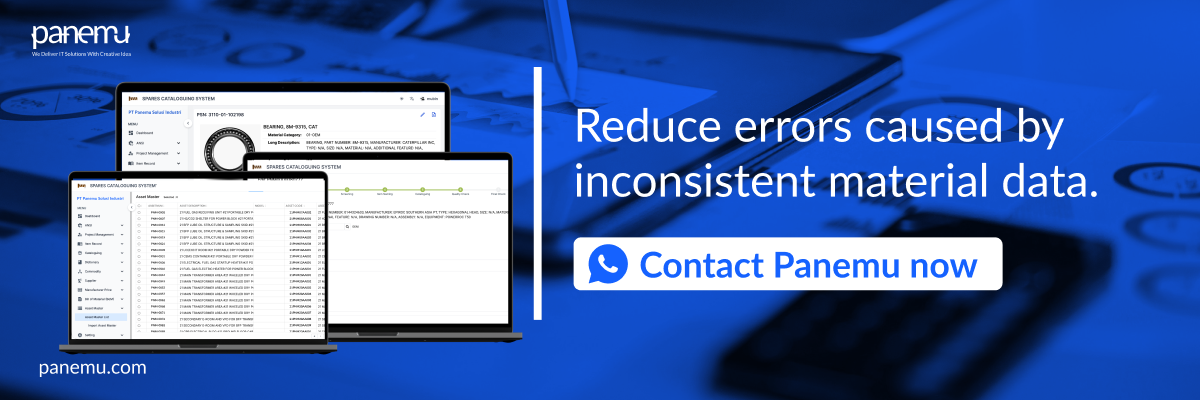
Unlocking SCM Productivity
Integrating SCS®-ANSI into daily operations ensures that only standardized, verified, and complete material data can populate your ERP. This structured approach directly accelerates the purchase requisition cycle, eliminating the common bottleneck where procurement is stalled by incomplete specifications or missing code approvals.
Warehouse teams gain absolute clarity on what is actually in stock, reducing failed issues and emergency expedites that disrupt planned maintenance schedules. Procurement gains a single, reliable source of truth for category spend analysis, which is what makes strategic sourcing and volume contract negotiation possible in the first place—you cannot consolidate spend on a part you don't know you already have three versions of.
Reliability and maintenance teams benefit too, in a way that is easy to overlook. Complete, attribute-rich specifications mean the right part is identified and issued the first time, rather than after a failed fit or a second trip to the warehouse. In environments where unplanned downtime carries a real cost per hour, that first-time-right rate is not a data quality metric—it is an availability metric.
What Good Screening Actually Catches
Duplicate screening under SCS®-ANSI is not a simple text match against existing descriptions, which is the limitation of most native ERP search functions. It cross-references manufacturer part numbers, functional attributes, and technical specifications to catch matches that a keyword search would miss entirely—the bearing requested by function versus the same bearing requested by brand, or a filter element described in metric dimensions versus the same item described in imperial units.
This is the layer of intelligence that free-text intake simply cannot replicate, no matter how well-intentioned the requester is. It requires both the structured workflow and the cataloguing expertise working together, at the moment the request is made—not a quarterly audit looking backward at what already went wrong.
Beyond Duplicates: Standardization at the Source
Stopping duplicates is the headline benefit, but the same gate delivers a second, quieter one: consistent naming and attribution across the entire organization, not just within a single warehouse. When every request passes through the same structured template and the same cataloguing standard, "Hyd. Filter element," "Filter, hydraulic," and "HF-102" don't just avoid becoming three records—they become one record described the same way whether the request originated in your Sumatra facility or your Kalimantan site.
That consistency is what makes cross-site inventory visibility possible in the first place. A planner at one location can see, with confidence, that an equivalent part exists at another location, rather than assuming it doesn't because the description doesn't match. It is also what makes category-level spend analysis meaningful: procurement can finally answer "how much do we actually spend on hydraulic filters across the enterprise" with one query, instead of reconciling a dozen naming variants by hand first.
The Gate Only Works If It's Never Skipped
The hardest part of intake governance is not designing the six steps above—it's enforcing them consistently, on every request, from every requester, every single day, including the ones submitted at 2 a.m. during an unplanned shutdown. A gate that can be bypassed under pressure isn't a gate; it's a suggestion.
That is why SCS®-ANSI is built as the mandatory path for Create, Change, and Delete requests rather than an optional check layered on top of existing habits. When screening is the only way a request reaches your ERP, duplicate prevention stops depending on individual diligence and becomes a property of the system itself.
**See SCS®-ANSI in Action**
Stop duplicates before they infect your database. PT Panemu Solusi Industri offers a Free Product Demonstration and SCM Consultation to show you how SCS®-ANSI seamlessly integrates with your existing SAP, Maximo, or Odoo ERP.
Schedule your session today by emailing [email protected] or contacting us on WhatsApp at +62 812-1590-2011. Discover more at panemu.com/scs.