A bearing recorded at one site as “BRG-6205-2RS-SKF.”
The same specification at another site entered as “Bearing 6205 2RS SKF.”
A third location registers “SKF Bearing 6205-2RS1.”
Operationally, these refer to the same component.
Systemically, they are three different materials.
Financially, they represent three stock lines.
Strategically, they dilute visibility.
This is the point where material cataloguing stops being administrative—and becomes structural.
Why Multi-Site Material Data Rarely Aligns by Default
Multi-site organizations evolve under operational pressure. Each facility optimizes for uptime, project deadlines, safety compliance, or regulatory targets. Material master data is shaped locally, often pragmatically.
Over time:
- Naming conventions diverge
- Units of measure vary
- Attribute depth becomes inconsistent
- Manufacturer references are embedded differently
- Classification hierarchies develop independently
Each site functions adequately within its own system logic. The challenge emerges when corporate leadership requires consolidated reporting—inventory exposure, procurement leverage, critical spare coverage, or working capital analysis.
The systems are capable.
The data foundation is not harmonized.
This is not a formatting issue. It is a master data governance issue.
The Hidden Cost of Duplication and Fragmentation
In asset-intensive industries, duplication within MRO material masters commonly ranges between 15–30%. The impact rarely appears as a single anomaly. Instead, it diffuses across operations:
Fragmented Data Condition | Enterprise-Level Consequence |
Multiple codes for identical materials | Fragmented spend leverage |
Inconsistent descriptions | Procurement clarification delays |
Missing technical attributes | Increased misidentification risk |
Unaligned classification | Limited cross-site visibility |
Duplicate safety stock | Inflated working capital |
Research from Gartner consistently emphasizes how poor master data quality constrains enterprise analytics and sourcing optimization. In multi-site environments, these inefficiencies scale rapidly.
The cost is not only financial. It is operational.
When maintenance searches the ERP during unplanned downtime and encounters multiple ambiguous material descriptions, time is lost validating dimensions, seal types, or manufacturer equivalence. The mechanical issue may be resolved quickly—but the data ambiguity amplifies recovery time.
The breakdown began long before the asset stopped. It began when structured cataloguing discipline was absent.
ERP Systems Reflect Master Data Integrity
Organizations invest significantly in ERP platforms—SAP, Oracle, and others—with the expectation of integration and control. Yet no ERP can compensate for inconsistent material master data.
When:
- Description logic is unstructured
- Attributes are optional or incomplete
- Units of measure are misaligned
- Duplicates remain active
Reporting becomes unreliable. Predictive maintenance models lose precision. Optimization tools generate misleading recommendations.
This is not a software limitation.
It is a structural data governance limitation.
A professional material cataloguing service addresses the issue at its root—standardizing description templates, harmonizing classification structures, validating technical attributes, and consolidating duplicates based on engineering equivalence rather than superficial similarity.

The Technical Complexity of Multi-Site Consolidation
From a distance, consolidation appears procedural: extract, compare, merge.
In practice, it is technical.
Two materials may share identical free-text descriptions but differ in pressure rating or metallurgy. A manufacturer suffix may indicate a critical dimensional variation. Slight specification differences can determine interchangeability—or failure.
Effective consolidation requires:
- Attribute-level technical validation
- Manufacturer reference reconciliation
- Equipment-to-material mapping review
- Risk assessment before rationalization
- Cross-site engineering alignment
Blind merging introduces operational risk. Blind separation preserves inefficiency.
Consolidation demands engineering understanding supported by structured cataloguing methodology.
Beyond Inventory Reduction: Strategic Operational Impact
Inventory reduction is often the visible outcome of structured cataloguing. However, the deeper impact extends further:
- Improved maintenance planning accuracy
- Strengthened bill of material (BOM) integrity
- Reduced emergency procurement
- Enhanced supplier negotiation leverage
- Increased audit and compliance transparency
- Clearer working capital analysis
When maintenance teams trust the material master, response time improves.
When procurement trusts consolidated data, negotiations strengthen.
When finance trusts inventory valuation, reporting gains credibility.
Trust in data is engineered—not assumed.
From One-Time Cleanup to Sustainable Governance
There is a decisive difference between cleansing and governing.
A one-time cleanup may temporarily reduce duplicates. Without controlled workflows and enforced standards, inconsistency re-emerges—especially during projects, expansions, or urgent procurement cycles.
Sustainable material data management requires:
- Defined naming conventions
- Structured classification hierarchies
- Mandatory technical attribute logic
- Controlled material creation workflows
- Clear data ownership across functions
Technology enables this discipline to scale.
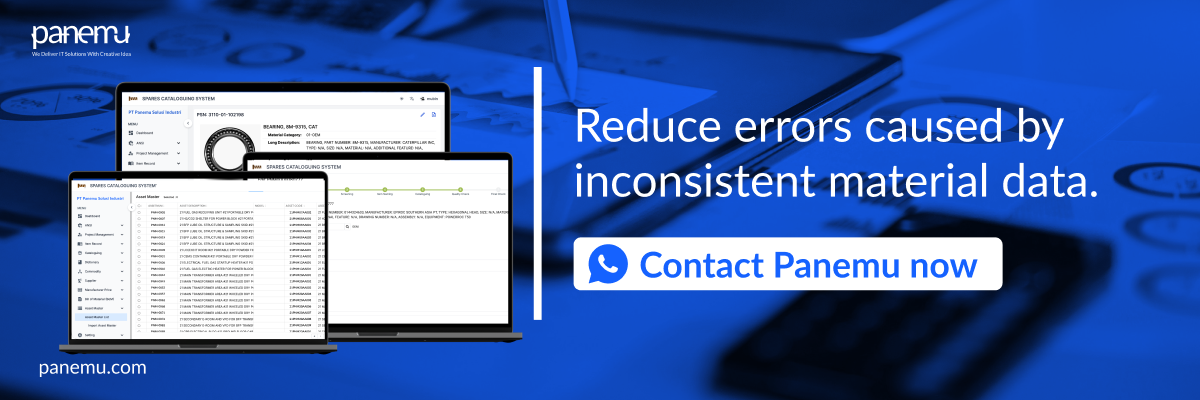
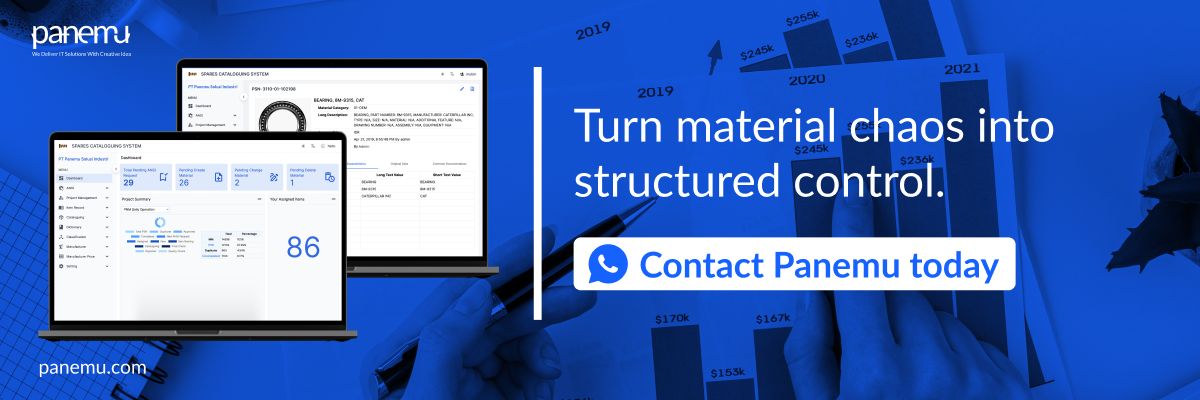
Frameworks such as the Spares Cataloguing System® (SCS®), developed by Panemu, provide structured templates, embedded classification logic, and rule-based governance to ensure that materials are described consistently at the point of creation. Instead of relying on free-text discretion, cataloguers operate within controlled logic that enforces completeness and reduces duplication risk.
The objective is not simply cleaner data.
It is controlled growth of the material master across all sites.
A Strategic Decision Point
Operational complexity is increasing. Asset portfolios are expanding. Supply chain volatility remains high. Working capital scrutiny is intensifying.
In this environment, fragmented material data quietly amplifies inefficiency.
Multi-site consolidation is not about correcting past practices. It is about strengthening the structural backbone of enterprise visibility and decision-making.
If inconsistent descriptions, duplication, or limited cross-site transparency are constraining your operational performance, the solution does not necessarily begin with system replacement. It begins with structured cataloguing and disciplined master data governance.
Executive Invitation: Free Consultation
Multi-site material consolidation touches engineering, maintenance, procurement, finance, and IT simultaneously. It requires technical validation while operations continue running. The complexity is real—but so is the opportunity.
We invite you to schedule a complimentary consultation session with our specialists to assess the current maturity of your material master data across sites. Together, we will identify duplication exposure, structural gaps, and practical pathways toward harmonized governance—supported by proven methodology and enabling technology.
The conversation may begin with a bearing code or a pump description.
The outcome is far greater: enterprise-level clarity built on accurate, standardized, and governed material master data.
Engage with us for a free consultation—and take the first step toward structured, multi-site material data excellence.