For many Asset Management and Maintenance Leaders, long-term asset strategy often revolves around reliability programmes, maintenance planning, shutdown optimisation, inventory control, and capital investment decisions. Yet there is a simpler question that frequently goes unanswered: can you trust the data behind those decisions?
The reality is that mature asset management does not begin with sophisticated dashboards, advanced analytics, or strategic frameworks. It begins with standardised, reliable, and searchable master data. When material master records are inconsistent, duplicated, or incomplete, even the most well-designed asset strategies struggle to deliver their intended outcomes.
In capital-intensive industries, every maintenance decision depends on information. Whether a planner is searching for a critical spare, a reliability engineer is analysing equipment performance, or a maintenance manager is preparing for a major shutdown, the quality of the underlying master data determines how effectively the organisation can act. A strong asset management strategy is only as strong as the data foundation supporting it.
Why Asset Management Depends on Standardised Material Master Data
Asset management is fundamentally about making informed decisions throughout the lifecycle of equipment and infrastructure. Those decisions rely heavily on accurate information regarding assets, spare parts, maintenance history, inventory levels, and procurement activities.
When material master data lacks standardisation, organisations often face multiple versions of the same spare part, inconsistent naming conventions, missing specifications, and unreliable inventory records. As a result, maintenance teams spend more time searching for information and less time focusing on equipment reliability.
Consider a common scenario in a processing plant. A critical pump fails unexpectedly. The maintenance team urgently searches the ERP or CMMS system for a replacement mechanical seal. The seal exists in inventory, but because it was entered under a different description several years ago, it cannot be easily found. Procurement is asked to purchase a new part, despite the required item already being available in the warehouse.
This is not simply a data problem. It becomes a maintenance problem, an inventory problem, a procurement problem, and ultimately an asset performance problem.
Standardised material master data creates a common language across maintenance, operations, procurement, warehousing, and supply chain teams. It enables faster decision-making, greater visibility, and improved confidence in maintenance planning activities.

The Hidden Cost of Weak Data Foundations
Many organisations underestimate the financial and operational impact of poor material master data because the consequences are often distributed across multiple departments.
For maintenance teams, the most visible impact is time. Technicians, planners, and reliability engineers frequently spend hours searching for spare parts, validating specifications, and confirming whether materials already exist within inventory.
Beyond lost productivity, poor data quality introduces significant operational risks.
Duplicate Materials. Multiple records for the same spare part create confusion and increase the likelihood of unnecessary purchases. Inventory carrying costs rise while warehouse visibility declines. Maintenance planners lose confidence in system information and begin relying on personal knowledge rather than enterprise data.
Incorrect Spare Selection. Inconsistent descriptions and missing technical attributes increase the risk of selecting the wrong component during maintenance activities. A seemingly small mistake can lead to equipment failures, rework, and additional downtime.
Inaccurate Bills of Materials. Effective preventive and planned maintenance relies on accurate Bills of Materials (BOMs). When material master records are inconsistent, BOM accuracy deteriorates, making maintenance planning more difficult and increasing shutdown risks.
Inventory Visibility Issues. Warehouse teams may physically possess critical spare parts, but poor cataloguing prevents maintenance personnel from finding them quickly. The organisation effectively loses access to assets it already owns.
Over time, these challenges accumulate. What begins as a data quality issue eventually weakens reliability initiatives, maintenance effectiveness, and asset performance programmes.
Long-Term Asset Strategy Requires Data Discipline
Organisations frequently invest significant resources in reliability-centred maintenance, predictive maintenance technologies, condition monitoring systems, and asset performance management platforms. These investments can deliver substantial value, but only when built upon reliable master data.
Imagine attempting to analyse spare parts consumption trends when duplicate material records exist across multiple locations. The resulting analysis may be inaccurate because usage is fragmented across several records representing the same item.
Similarly, predictive maintenance programmes depend on accurate asset hierarchies, equipment records, and maintenance histories. If foundational data is inconsistent, advanced analytics may generate misleading conclusions.
Long-term asset strategies require consistency over time. Maintenance teams change. Systems evolve. Equipment ages. Yet master data remains the institutional memory that supports decision-making across decades.
When master data governance is neglected, organisations gradually lose confidence in their systems. Employees create workarounds, spreadsheets multiply, and tribal knowledge becomes more valuable than enterprise information.
This creates a dangerous dependency. When experienced personnel retire or move on, critical operational knowledge often leaves with them.
Standardised material master data reduces this risk by creating a reliable and searchable source of truth that supports the organisation regardless of personnel changes.

How a Spares Cataloguing System Strengthens Asset Management
Many organisations recognise the importance of master data quality but struggle with implementation. Manual clean-up efforts are often time-consuming, inconsistent, and difficult to sustain.
This is where a dedicated Spares Cataloguing System becomes particularly valuable.
Rather than treating material master data as a static database, a modern Spares Cataloguing System transforms it into a governed operational asset.
Intelligent Search Engine. Maintenance personnel need to find the right spare quickly, especially during equipment failures. Advanced search capabilities allow users to locate materials using technical specifications, attributes, manufacturer references, or alternative keywords. This significantly reduces search time and improves maintenance responsiveness.
Master Data Management. Centralised governance ensures material records follow consistent standards. Standard naming conventions, controlled attributes, and structured descriptions improve data quality across the organisation.
Data Normalisation. One of the most common challenges in material master data is inconsistency. Normalisation capabilities standardise descriptions, units of measure, technical specifications, and classification structures. This creates a common language across departments and locations.
Duplicate Detection. Duplicate materials can consume significant inventory budgets and reduce visibility. Automated duplicate identification helps organisations detect and consolidate redundant records, reducing inventory complexity and improving procurement efficiency.
Classification and Standards Compliance. Consistent classification frameworks such as NSC and UNSPSC improve material discoverability and reporting accuracy. Proper classification enables better inventory analysis and supports enterprise-wide governance initiatives.
By strengthening these core capabilities, a Spares Cataloguing System helps maintenance teams spend less time searching for information and more time improving equipment reliability.
Integrating Master Data with ERP, EAM, and CMMS Platforms
Many organisations assume that implementing an ERP, EAM, or CMMS platform will automatically solve data quality challenges. In practice, the opposite often occurs.
A sophisticated system cannot compensate for poor data quality. In fact, bad data frequently becomes more visible after system implementation.
Maintenance leaders regularly encounter situations where their ERP or CMMS contains thousands of material records but provides limited practical value because descriptions are inconsistent and searchability is poor.
A dedicated cataloguing approach enhances the effectiveness of existing enterprise systems by improving the quality of the information stored within them.
ERP Integration. Accurate material master data improves procurement processes, inventory management, reporting accuracy, and spend visibility. Standardised records enable more effective sourcing and supplier management.
CMMS Integration. Maintenance planning becomes more efficient when technicians and planners can quickly identify the correct materials required for work orders and preventive maintenance activities.
EAM Integration. Asset lifecycle management benefits from improved data consistency, allowing organisations to analyse maintenance costs, reliability trends, and inventory consumption more effectively.
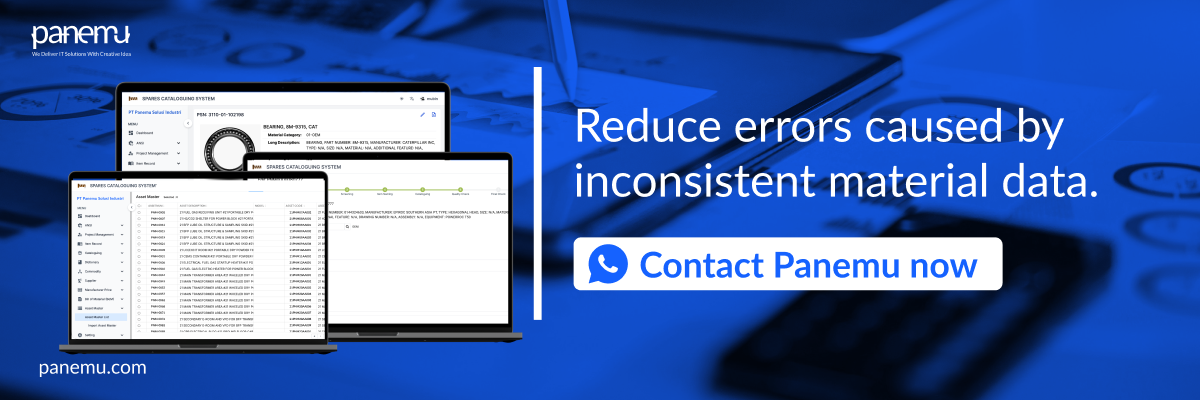
When integrated correctly, a Spares Cataloguing System acts as a data quality layer that enhances the performance of existing enterprise platforms rather than replacing them.
Measuring the Return on Better Material Master Data
Asset Management and Maintenance Leaders are increasingly expected to justify investments using measurable business outcomes. Fortunately, improvements in material master data quality often generate clear and tangible returns.
The most immediate benefit is reduced maintenance delays. Faster spare identification improves response times and helps minimise unplanned downtime.
Inventory optimisation is another significant opportunity. By eliminating duplicate materials and improving visibility, organisations frequently discover excess inventory that can be consolidated or redeployed.
Procurement efficiency also improves. Buyers gain greater confidence in material specifications, reducing unnecessary purchases and supplier-related issues.
Maintenance planning becomes more reliable because planners can trust BOMs, inventory records, and spare part information. This improves shutdown readiness and reduces execution risks during critical maintenance events.
From a strategic perspective, improved master data creates a foundation for future digital transformation initiatives. Reliability analytics, predictive maintenance programmes, and advanced asset management technologies all perform more effectively when supported by accurate and standardised data.
The organisations achieving the greatest success with asset management are often not those with the most sophisticated technology. They are the organisations that have invested in creating a trustworthy information foundation.
Conclusion
Mature asset management begins long before strategic planning workshops, predictive analytics projects, or reliability improvement programmes. It begins with data.
When material master records are inconsistent, duplicated, or difficult to search, every maintenance process becomes harder. Maintenance planning slows down. Inventory visibility declines. Procurement efficiency suffers. Reliability initiatives struggle to achieve their full potential.
Conversely, when material master data is standardised, governed, and easily searchable, maintenance teams can find the right spare parts faster, improve planned maintenance execution, and support long-term asset performance objectives with greater confidence.
A strong asset management strategy requires a strong foundation. In most organisations, that foundation is material master data.
Start With the Foundation Before the Next Asset Initiative
Before launching another reliability programme, inventory optimisation project, or digital transformation initiative, consider a simpler question:
Can your maintenance team consistently find and trust the material data they need to keep equipment running?
When material master records are inconsistent, maintenance planning slows down, duplicate purchases increase, inventory visibility becomes limited, and valuable time is spent searching for information instead of improving asset performance.
In many cases, the problem is not the ERP system. It is not the CMMS platform. It is not the capability of the maintenance team. The real challenge lies in the quality, governance, structure, and searchability of the Material Master Data supporting those systems.
That is why, at Panemu, we help organisations understand the true condition of their Material Master Data through a complimentary consultation and data assessment. Our team identifies hidden data quality issues, evaluates cataloguing effectiveness, and provides practical recommendations to strengthen the foundation supporting maintenance, procurement, inventory management, and asset performance.
Because better maintenance decisions start with better data.
And some of the largest cost-saving opportunities come not from reducing inventory, but from gaining visibility into what already exists.
Curious whether your Material Master Data is helping your asset strategy succeed—or quietly holding it back?
Send a sample of your Material Master Data or schedule a complimentary assessment discussion with Panemu. Learn how stronger Material Master Cataloguing and a well-governed Spares Cataloguing System can support maintenance excellence and long-term asset performance.
Visit: https://panemu.com/scs-key-feature
For organisations exploring broader cataloguing and governance initiatives, you may also find value in Panemu’s Material Master Data and cataloguing solutions available through the Panemu platform. This assessment is often the most practical first step before any major asset management or system improvement initiative.