The Savings Number on Your Slide Is Only as Strong as the Data Behind It
Every fiscal year starts the same way. The board sets a procurement savings target. Your team commits to it. The number lands on a slide, gets presented with confidence, and everyone nods.
Three quarters later, the gap between the target and realized savings becomes impossible to ignore. Not because your team lacks capability, and not because the strategy was wrong. The target falls short because the underlying data was never fit for the job.
This is a pattern that repeats across asset-intensive industries — mining, oil and gas, power generation, manufacturing. Procurement leaders inherit MRO (Maintenance, Repair, and Operations) master data that has been accumulating inconsistencies for years: duplicate records for the same part, unstandardized descriptions that prevent spend aggregation, and a supplier base that has grown unchecked because nobody could see the full picture.
The consequence? Demand consolidation becomes guesswork. Vendor rationalization stalls. Competitive bidding exercises run on incomplete category data. And the savings target — however well-intentioned — remains a number on a slide.
If this sounds familiar, consider what follows not as a product pitch, but as a diagnostic of the structural gap between procurement ambition and procurement execution. And then consider what it would mean for your organization if that gap were closed.

Why Most Enterprise Procurement Savings Targets Remain Underachieved
The data deficit you cannot afford to overlook
Procurement savings are validated through hard evidence: negotiated price reductions, SKU rationalization, and supplier consolidation — all measured against a clear baseline of historical purchase orders and actual spend. Without that baseline, even the most aggressive sourcing strategy lacks a starting point.
Here is where the challenge becomes structural rather than tactical. In organizations managing tens of thousands of MRO parts across multiple plants, the material master data inside ERP systems is often deeply compromised. Research by Verdantis across 1,900 global operations leaders has documented that enterprises routinely struggle with data quality, MRO inefficiencies, and fragmented procurement processes — all of which directly erode savings potential.
Consider how this plays out in practice. When the same component exists under multiple stock-keeping units because it was entered by different teams with different naming conventions, total spend becomes split across unrelated records, hiding true purchase volume and obscuring unit cost trends. Procurement cannot leverage consolidated volume. Pricing negotiations happen in silos. Contract rates are bypassed when descriptions differ from catalog standards, producing uncontrolled expenditures and eroding negotiated savings across multiple facilities.
Research from GEP has shown that organizations achieving proper SKU rationalization can unlock 3–5% in cost savings through reduced inventory holding costs, lower transportation expenses, and consolidated supplier pricing. But that rationalization is impossible without standardized, deduplicated material data as its foundation.
The RS 2025 Indirect Procurement Report further illustrates the pressure: 62% of respondents cited reduced operational budgets as a top concern — a sharp increase from 31% the prior year — while the average supplier base grew 18%, rising from 75 to 92 suppliers. More suppliers with tighter budgets and unstandardized data is a formula for fragmentation, not savings.
The Anatomy of a Failed Savings Target
Five data problems that procurement teams inherit
Before you can solve the problem, you need to see it clearly. The following table maps the most common MRO data failures to their direct impact on your procurement savings agenda:
Data Problem | Operational Consequence | Impact on Savings Target |
Duplicate material records across plants | Spend is split across unrelated SKUs, hiding true purchase volume | Volume-based pricing leverage is lost; negotiated contracts are bypassed |
Unstandardized part descriptions | Buyers cannot identify equivalent items or approved alternatives | Competitive bidding runs on incomplete data; savings opportunities are missed |
No consistent classification (e.g., NATO/UNSPSC) | Category spend analysis is unreliable | Demand consolidation across categories becomes impossible |
Knowledge concentrated in individual personnel | Operational risk when key staff are unavailable | Procurement decisions default to reactive, emergency purchasing at premium cost |
No automated duplicate screening | New duplicates are continuously created | Any data cleanup effort degrades within months, wasting prior investment |
Each of these problems is a direct drag on your ability to deliver the savings number your organization expects. And they compound. When you combine duplicate records with unstandardized descriptions and no classification system, you are not dealing with a minor data hygiene issue — you are dealing with a structural inability to execute procurement strategy.
What Changes When Your Material Data Is Standardized
From reactive purchasing to strategic procurement
Imagine walking into your next category review with complete visibility: every MRO item across every plant, classified under a consistent taxonomy, with standardized descriptions, verified specifications, and identified duplicates already merged. That is not an idealized scenario. It is the operational baseline that standardized material data provides.
When your data is structured this way, three critical procurement capabilities unlock simultaneously:
- Demand Consolidation Becomes Fact-Based. When identical parts across multiple facilities are properly identified and unified under a single record, total organizational demand becomes visible for the first time. You can aggregate volume with confidence, approach suppliers with a consolidated requirement, and negotiate from a position of documented demand rather than estimated guesswork.
- Vendor Rationalization Gains Precision. Global studies have shown that cross-company parts pooling — enabled by shared, standardized catalogs — can reduce procurement costs by 13% and inventory costs by 21%. But pooling requires that parts data be clean, consistent, and comparable. Without standardization, you are rationalizing vendors based on incomplete information, which means either cutting suppliers you still need or keeping suppliers you should have consolidated years ago.
- Competitive Bidding Becomes Genuine. A bidding exercise is only as competitive as the specification it carries. When your material descriptions are standardized with proper attribute templates — correct part numbers, dimensional data, material grades, manufacturer references — alternative suppliers can quote accurately. When descriptions are vague or inconsistent, you receive quotes that are not comparable, leading to pricing distortions that undermine the entire exercise.
These are not incremental improvements. They represent a shift from reactive, transactional procurement to strategic, data-driven sourcing. And for a Procurement Director accountable to an ambitious savings target, that shift is the difference between presenting progress and presenting excuses.
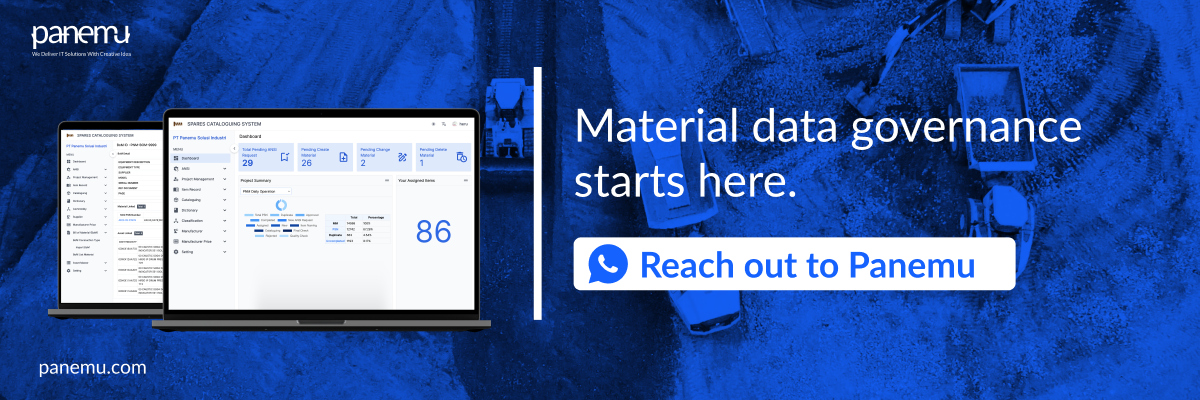
Spares Cataloguing System®: The Data Foundation Your Savings Target Requires
Purpose-built for MRO material data standardization in enterprise environments
This is where the Spares Cataloguing System® (SCS®) from Panemu fits into your procurement equation — not as a peripheral tool, but as the data enabler that makes everything else in your savings strategy work.
SCS® is a software system tailored to aid your organization in overseeing asset information data at the component level, particularly MRO spare parts. It was built for the reality of enterprise operations: multiple plants, tens of thousands of parts, legacy ERP systems carrying years of accumulated data inconsistencies, and cross-functional teams that need a single, reliable source of truth.
What makes SCS® directly relevant to your savings agenda is its approach to four interrelated data challenges that every Procurement Director faces:
- Classification Standardization. SCS® can adopt material standardization based on NATO, UNSPSC, eCl@ss, and other industry standards, while allowing flexible codification adjustments tailored to your company's needs. This means your category spend analysis is built on a classification framework that is both globally consistent and operationally relevant to your organization.
- Dictionary-Driven Description Standardization. The system maintains a controlled dictionary of item names following the Noun-Modifier structure, ensuring every material description in your catalog follows a consistent format. Attributes or characteristics can be text or numeric, mandatory or otherwise, and placed in a specific order to create output descriptions to suit your enterprise systems.
- Automated Duplicate Screening. The system automatically conducts a check as soon as the Part Number or Description is entered. If the item already exists in the system, its details will be displayed, and the item can be merged or further enhanced. This prevents the cycle of continuous duplication that plagues most enterprise material masters.
- ERP Integration and Customization. SCS® is designed for seamless integration with your existing enterprise systems. This software can be tailored to meet your specific needs and seamlessly integrated into your ERP System. Data flows into your ERP — whether SAP, Oracle, Odoo, or others — without requiring your teams to manage parallel databases or manual data transfers.
The system also supports bulk operations for item naming, codification, and manufacturer assignment, which means your data standardization effort does not have to be a multi-year project that loses momentum before it delivers value. And because SCS® is backed by Panemu's professional cataloguing team — experienced practitioners who work according to ISO 8000 data quality standards — you are not simply licensing a tool. You are engaging a partner with direct experience in MRO data optimization across mining, oil and gas, power generation, and manufacturing sectors.
Building the Business Case: From Data Investment to Procurement Return
Connecting the investment to the board-level number
As a Procurement Director, you know that any initiative competing for budget must demonstrate return. So let us connect the dots between SCS® implementation and your savings target.
The business case rests on three measurable outcomes:
- Reduced Procurement Costs Through Volume Consolidation. Once duplicate records are eliminated and demand is consolidated, your sourcing team can approach suppliers with accurate, aggregated volume. One of the most effective MRO cost reduction strategies is standardization — when organizations reduce duplicate SKUs, limit unnecessary brand variation, and align internal users around approved parts, procurement teams gain leverage. The savings come not through aggressive negotiation alone, but through the simple act of knowing exactly what you buy, how much, and from whom.
- Lower Inventory Carrying Costs. Duplicate records directly contribute to excess inventory. When the same part sits under multiple SKUs, storerooms accumulate redundant stock that ties up working capital. Global studies show average factory MRO inventories exceed EUR 109 million, with 41% of parts never used. Eliminating even a portion of duplicate-driven overstock releases capital that can be redeployed or returned to the bottom line.
- Reduction in Emergency and Off-Contract Purchasing. Emergency orders often come with expedited freight, premium pricing, and increased downtime risk. Standardized data enables planned procurement, contract compliance, and fewer costly surprises. When material data is reliable, maintenance teams can plan ahead rather than default to reactive ordering.
These outcomes are not theoretical. They are the documented results of organizations that have invested in structured MRO data management. Global MRO procurement spend reached $1.1 trillion in 2023 for industrial sectors alone. Even fractional improvements in data-driven efficiency across that scale represent substantial financial impact for individual enterprises.
Why a Generic Approach to Data Cleanup Falls Short
The difference between a one-time project and a sustainable system
You may have already invested in data cleanup initiatives — whether through internal IT projects, ERP migration-driven cleansing, or third-party data services. If those efforts delivered lasting results, you would not still be facing the same problems.
The reason most data cleanup projects fail to sustain their impact is that they treat data quality as a one-time event rather than an ongoing operational discipline. Records are cleansed, duplicates are merged, descriptions are standardized — and then, within months, the old patterns return because the system that creates new records has not changed.
SCS® addresses this directly. It is not a cleanup tool. It is a cataloguing system — a governed workflow that ensures every new material record entering your master data is created according to defined standards, screened for duplicates, and enriched with the correct attributes before it reaches your ERP. The difference is the difference between mopping the floor and fixing the leak.
For procurement, this means the data you rely on for spend analysis, supplier negotiations, and category management does not degrade over time. Your investment in data quality compounds rather than depreciates. And your savings targets can be built on a foundation that holds up quarter after quarter.

Your Savings Target Deserves More Than Good Intentions
Ambitious procurement targets are a sign of organizational confidence. They signal that leadership believes in the procurement function's ability to deliver strategic value. But confidence without capability is risk.
The capability gap, in most enterprise organizations, is not in people or strategy. It is in data. Specifically, it is in MRO material data that has never been properly standardized, classified, deduplicated, and governed. Until that data is addressed, every other procurement initiative — from demand consolidation to vendor rationalization to competitive bidding — operates at a fraction of its potential.
Spares Cataloguing System® (SCS®) was built to close that gap. Not as a theoretical framework, but as a working system deployed in real enterprise environments across mining, oil and gas, power generation, and manufacturing. It is supported by a professional cataloguing team, integrated with your ERP, aligned with international data quality standards (ISO 8000, NATO Codification System, UNSPSC), and designed to deliver sustained results rather than temporary fixes.
If your savings target is going to move from the slide to the ledger, it starts with the data. And if the data is going to be reliable, it starts with the right system and the right partner.
Your Next Move Starts Here.
Every quarter that passes with unstandardized data is a quarter of savings left unrealized — not lost to competition, not lost to market conditions, but lost to a problem that has a solution.
The Panemu team is ready to sit down with you, assess where your MRO material data stands today, and map out exactly how SCS® fits into your procurement savings roadmap. No generic presentations. No templated proposals. A focused conversation built around your operations, your data challenges, and your targets.
One form. One conversation. That is all it takes to find out what your data is actually costing you — and what it could be delivering instead.
Fill out the consultation form Here.
Panemu — Committed to providing the best practice of technical solutions for your organization.