Many enterprises conduct periodic criticality assessments. Teams evaluate spare parts based on safety impact, production consequence, lead time, redundancy, and historical failure. Items are labeled as “Critical,” “High,” “Medium,” or “Low.”
On paper, the model appears robust.
However, when the underlying material master lacks structured classification, inconsistencies emerge:
- Similar components are assessed differently across sites.
- Functional equivalents are not recognized.
- Low-cost but high-impact items are underestimated.
- High-cost but operationally redundant items are over-prioritized.
The result is not immediately visible. It appears in subtle distortions—overstock in some categories, exposure in others, inconsistent reporting across business units.
Criticality decisions are only as reliable as the structure supporting them.

The Strategic Role of Material Classification
Material classification is not a reporting convenience. It is a technical framework that defines how an organization understands its own components.
A professional classification structure typically establishes:
- Clearly defined material classes (e.g., rotating equipment component, electrical distribution device, instrumentation control element)
- Logical subclasses aligned to functional application
- Mandatory technical attributes per class (dimension, rating, material specification, voltage class, pressure class, hazardous area rating, etc.)
- Standardized description sequencing and abbreviation logic
- Controlled vocabulary and data validation rules
This framework creates technical identity.
When identity is consistent, evaluation becomes comparable. When evaluation is comparable, prioritization becomes objective.
And objectivity is essential at enterprise scale.
Why Classification Must Precede Criticality
Criticality is fundamentally about consequence and probability. But consequence cannot be accurately measured if the technical context of a material is unclear.
Consider two seemingly similar components: pressure transmitters.
Without structured classification, both may simply appear as “Instrument – Pressure.” Yet one may monitor a non-critical auxiliary system, while the other safeguards a high-pressure production line in a hazardous environment.
If classification does not capture:
- Measurement range
- Hazardous area certification
- Asset association
- Functional role
Then criticality evaluation becomes superficial.
Classification provides the context that transforms a part number into a risk indicator.
It reveals which components protect safety, which sustain throughput, and which can tolerate delay.
The Enterprise Impact of Misaligned Criticality
In large-scale operations, even minor misclassification creates measurable consequences.
Over-classification leads to:
- Excess safety stock
- Inflated working capital
- Increased storage and handling complexity
Under-classification leads to:
- Emergency procurement
- Premium freight costs
- Elevated downtime risk
- Reputational and compliance exposure
Research from McKinsey & Company consistently indicates that structured inventory segmentation—grounded in reliable data—can significantly reduce inventory levels while sustaining or improving service performance.
Segmentation depends on clarity.
Clarity depends on classification.
Without disciplined classification, segmentation becomes arbitrary. And arbitrary segmentation erodes both capital efficiency and operational resilience.

Multi-Site Complexity: Where Standardization Matters Most
The importance of classification becomes even more pronounced in multi-site environments.
One site may designate a specific motor as critical due to single-source procurement and long international lead time. Another site, operating similar equipment, may treat it as standard stock because redundancy exists locally.
Without harmonized classification standards:
- Enterprise-level reporting becomes inconsistent.
- Risk exposure varies between sites.
- Stock transfer optimization is limited.
- Global sourcing leverage is weakened.
Standardized material classification aligns risk perception across locations. It ensures that when leadership reviews consolidated data, the prioritization logic is consistent and defensible.
Enterprise visibility begins with structural uniformity.
Embedding Operational Knowledge into Data Architecture
Operational teams possess invaluable knowledge about which components truly matter. They understand the difference between inconvenience and operational shutdown. They know which suppliers are unreliable and which lead times are unpredictable.
However, if that insight remains informal, it is vulnerable.
Personnel changes. Organizational structures evolve. Informal knowledge dissipates.
A structured classification system captures this experience and embeds it into the material master itself. It transforms practical insight into institutional capability.
That transformation strengthens long-term resilience.
Governance: Protecting the Integrity of Classification
Classification must be actively governed to remain effective.
Without governance controls:
- New materials are created without proper class assignment.
- Attribute fields remain incomplete.
- Description standards degrade over time.
- Criticality tags drift from original intent.
Sustainable classification requires:
- Mandatory classification prior to material activation
- Defined approval workflows
- Standardized attribute templates per class
- Periodic audit and alignment reviews
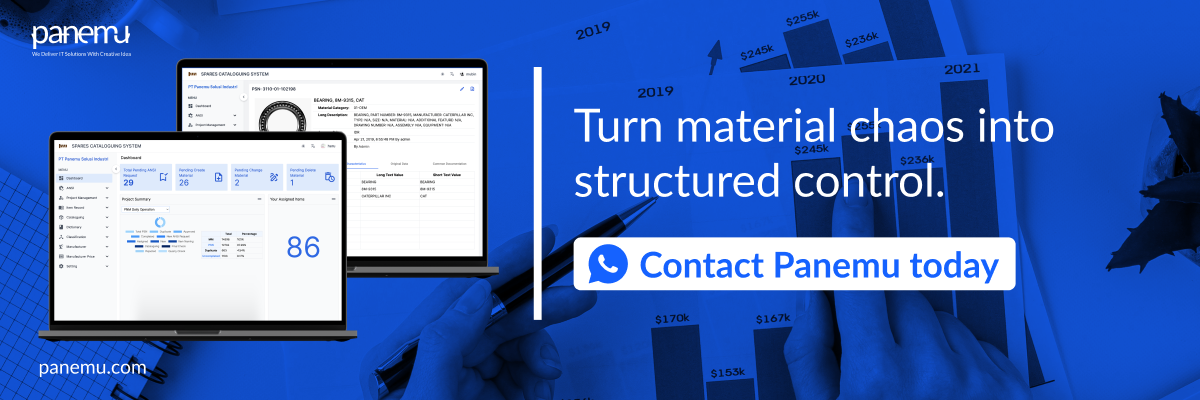
Frameworks such as the Spares Cataloguing System® (SCS®), developed by Panemu, integrate structured, attribute-driven classification into the material creation lifecycle. By enforcing taxonomy logic, validating technical completeness, and preventing duplication, SCS® reinforces the reliability of downstream criticality assessments.
The objective is continuity.
Not just structured data today—but protected prioritization tomorrow.
From Structured Classification to Strategic Spare Part Policy
When classification and criticality are aligned, spare part management becomes differentiated and intentional.
Enterprises can confidently implement:
- High-criticality strategy: strategic stocking levels, supplier redundancy, defined service targets
- Medium-criticality strategy: optimized safety stock based on consumption and risk profile
- Low-criticality strategy: lean inventory, potential vendor-managed solutions
Capital allocation becomes proportional to risk.
Procurement strategy aligns with operational consequence.
Inventory policy becomes analytical rather than reactive.
This is where spare part management transitions from cost center to strategic enabler.
Enabling Advanced Asset Strategies
Predictive maintenance, reliability-centered maintenance, and advanced analytics all depend on structured data. Algorithms require consistency. Models require comparability.
If classification is inconsistent, analytical outputs become unreliable.
Digital ambition cannot exceed data discipline.
Material classification provides the structural grammar required for scalable insight. It ensures that as systems become more intelligent, the underlying data remains coherent.
A Moment of Strategic Reflection
Spare part criticality is ultimately about governance of operational risk. It reflects how rigorously an organization defines, measures, and mitigates exposure.
If classification lacks structure, criticality remains subjective.
If classification is consistent and governed, criticality becomes defensible and strategic.
The difference is significant—particularly in enterprises where downtime, safety exposure, and capital intensity are measured in substantial terms.
This is the moment to evaluate:
- Is your material classification framework technically consistent across all sites?
- Is criticality assessment built on structured attributes or influenced by local interpretation?
- Does your material master support enterprise-level prioritization with confidence?
If uncertainty remains, the foundation deserves structured review.
Reassess your taxonomy. Align classification with asset hierarchy. Embed governance into material creation workflows. Explore structured methodologies such as Spares Cataloguing System® (SCS®).
Because in enterprise operations, resilience is not accidental.
It is designed.
Schedule a Strategic Executive Consultation Today. Strengthen your classification architecture—and transform spare part criticality into a disciplined, enterprise-wide risk strategy.