In many organisations, cost increases do not always come from large capital investments or major operational failures. Often, they grow quietly through small inefficiencies that repeat every day. One of the most overlooked sources of these hidden costs is unstandardised material data.
Different descriptions for the same spare part, inconsistent units of measure, missing technical attributes, and uncontrolled material creation may look like simple data issues. In reality, they create a chain reaction that affects procurement, inventory, maintenance, finance, and IT. Over time, these small inconsistencies become structural problems that inflate operational costs and reduce business performance.
Unstandardised material data does not cause one visible crisis. It slowly erodes efficiency, accuracy, and trust in systems. Many organisations realise this only when inventory levels are high, procurement cycles are slow, and operational teams struggle to make confident decisions.

How Cost Growth Starts from Data Inconsistency
Every material record is a representation of a physical asset or spare part. When that representation is unclear or inconsistent, the system cannot support the business correctly.
A simple example is when the same item is registered under different names or formats. One user enters a manufacturer part number, another uses a local description, while a third adds a shortened version. Each record looks unique, even though the physical item is the same.
As a result, the system believes there are three different items. Each may have its own stock level, supplier, and pricing history. When one is out of stock, the system does not automatically recognise the others as alternatives. Procurement teams then reorder, even though the item already exists in another form.
This is how unnecessary costs begin. Not because of one wrong decision, but because the data structure does not allow the organisation to see clearly.
The Direct Financial Impact of Duplicate and Inconsistent Materials
One of the most visible cost drivers is duplicate material records. When duplicates exist, inventory appears lower than it actually is. This triggers new purchases, often at premium or urgent prices.
Over time, warehouses fill with similar items that serve the same purpose but are stored under different codes. Each duplicate increases holding costs, storage space, insurance, and handling effort.
Procurement also loses the opportunity to consolidate demand. When the same item is split across multiple records, volume discounts are missed, and supplier negotiations become weaker. The organisation pays more simply because it cannot see its true purchasing power.
These costs do not appear as one large expense. They are spread across departments and budgets, which makes them harder to detect and control.
Excess Inventory as a Result of Poor Visibility
Unstandardised data reduces inventory visibility. When users cannot trust the system, they rely on experience, manual checks, or safety stock. This leads to overstocking.
Excess inventory ties up working capital that could be used for strategic investments. It also increases the risk of obsolescence, especially for spare parts that change with equipment upgrades or supplier changes.
In many cases, the parts exist, but they are not found because they are hidden behind inconsistent descriptions or classifications. The organisation is paying to store items it does not know it has.
Process Inefficiency and Its Hidden Costs
Material data affects every transaction. When data is inconsistent, users spend more time searching, validating, and correcting information. What should take minutes turns into hours.
Procurement teams review unclear descriptions. Maintenance planners verify part compatibility manually. Warehouse staff clarify ambiguous codes. IT teams handle data corrections and system issues.
Each small delay increases labour costs. More importantly, it reduces productivity and slows down critical processes. These inefficiencies are rarely calculated, but they accumulate across thousands of transactions.
The Impact on Maintenance and Asset Reliability
When spare parts are difficult to identify or locate, maintenance activities are delayed. This increases downtime risk and forces reactive repairs instead of planned maintenance.
Emergency procurement is more expensive than standard purchasing. It often involves higher prices, express shipping, and unplanned approvals. These costs are directly linked to data quality, even if they are not labelled as such.
Asset reliability suffers when the right parts are not available at the right time. Over time, this affects production output, safety, and regulatory compliance.
Why ERP Systems Alone Cannot Solve This
Many organisations believe that implementing or upgrading an ERP system will fix data problems. In reality, systems only process the data they receive.
If the material master is inconsistent, the ERP will reflect that inconsistency. Automation will only make errors happen faster.
Without standardisation, even the most advanced system cannot provide reliable insights. Reports may look accurate, but they are built on flawed foundations.
Material Cataloguing as a Cost Control Strategy
Material cataloguing is not an administrative exercise. It is a financial control strategy.
By standardising naming conventions, classifications, and technical attributes, organisations create a single source of truth. Duplicate materials are identified and merged. Visibility improves. Procurement decisions become data-driven.
With a clean material master, demand can be consolidated, inventory optimised, and supplier relationships strengthened. This directly reduces operational costs.
Long-Term Savings Through Data Governance
Standardisation must be supported by governance. Clear rules for material creation, validation, and maintenance prevent new inconsistencies from entering the system.
This protects the investment in data quality and ensures that cost savings are sustained over time.
Governance also improves cross-functional collaboration. Everyone works from the same data structure, reducing misunderstandings and rework.
Panemu as Your Partner in Data-Driven Cost Efficiency
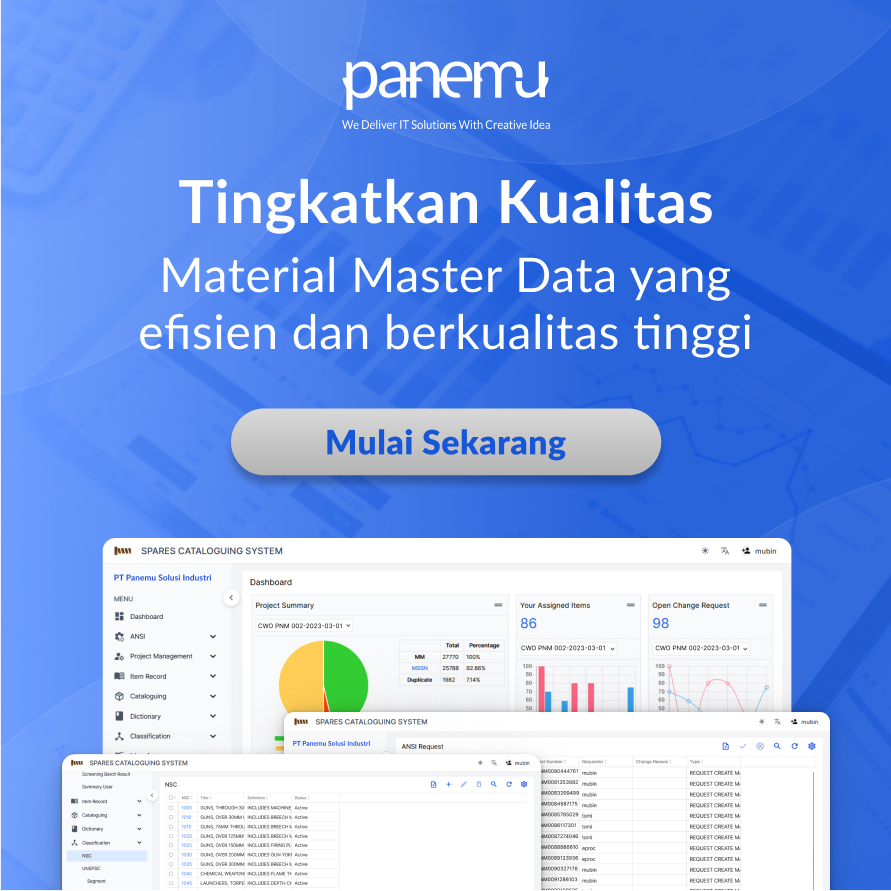
Panemu helps organisations transform material data into a reliable business asset. Through structured material cataloguing, data cleansing, and governance design, Panemu supports long-term operational efficiency.
This approach does not focus on software alone. It focuses on how data supports real business processes.
Turning Data into Measurable Value
The cost implications of unstandardised material data are real, even if they are not always visible. They appear in excess inventory, repeated purchases, inefficient processes, and delayed maintenance.
By addressing the root cause, organisations can regain control over their operational costs and improve system reliability.
If your organisation is experiencing gradual cost increases without a clear explanation, the answer may lie in your material data. Panemu is ready to help you uncover that value and build a stronger foundation for sustainable performance.