If you're an ERP Director running a corporate group with HQ on SAP S/4HANA or Oracle Cloud and subsidiaries on Odoo, Dynamics, or local ERPs, you already know the quiet disaster lurking in your monthly close: the same physical part exists under three different material codes across your tiers, your consolidated inventory report is a polite fiction, and your analysts spend 30–50% of their time on manual reconciliation that no integration platform has been able to fix. The reason middleware alone hasn't solved this — and won't — is that your architecture is missing a layer that integration tools were never designed to provide: a purpose-built material master data hub. The Panemu Spares Cataloguing System® (SCS®) is exactly that hub. It is the only platform in the region engineered as the authoritative source of group master data, with native distribution to every ERP in your two-tier (or N-tier) architecture. Engage now — every quarter you operate without it, the reconciliation tax compounds and your M&A roadmap absorbs avoidable integration cost.
The Two-Tier ERP Reality — And Why It Breaks at the Master Data Layer
Two-tier ERP wasn't a strategic decision for most enterprise groups in Indonesia and Southeast Asia — it was an accumulation. Headquarters runs SAP S/4HANA or Oracle Cloud ERP because the CFO needs IFRS-compliant consolidation, statutory reporting at group level, and the analyst credibility that comes with a Tier-1 platform. The subsidiaries — regional operating companies, recently acquired entities, joint ventures, business units serving local markets — run something lighter. Odoo. Microsoft Dynamics Business Central. SAP Business One. Infor SyteLine. A locally-built ERP nobody can replace without operational disruption.
The architecture itself is rational. A USD 5 billion mining group does not need a newly-acquired 80-person logistics subsidiary on full S/4HANA. A power generation holding does not force every IPP and O&M entity onto Oracle Fusion. Two-tier ERP is the pragmatic answer to a cost-versus-control tradeoff.
But the architecture has a catch — and it's the catch that turns ERP Directors into reconciliation managers. Two-tier ERP only delivers its promised benefits when master data is genuinely consistent across the tiers. And master data consistency does not happen through goodwill, quarterly Excel reconciliations, or middleware pipelines alone. It happens only when there is a single authoritative source of master data that feeds every ERP in the architecture — a purpose-built hub with the data quality, governance, and distribution capabilities the discipline requires.
That hub is what SCS® is built to be — not as a feature, but as its core architectural purpose. And without it, you continue paying the reconciliation tax, the decision tax, and the M&A integration tax every quarter you delay. Engage Panemu now — our enterprise architecture engagements for the coming quarter are filling, and ERP architecture decisions don't wait for the next budget cycle.
What a Material Master Data Hub Actually Is — The SCS® Architecture
The phrase "master data hub" gets used loosely. Let me be precise about what SCS® delivers architecturally, because the specifics matter for any ERP Director evaluating the platform.
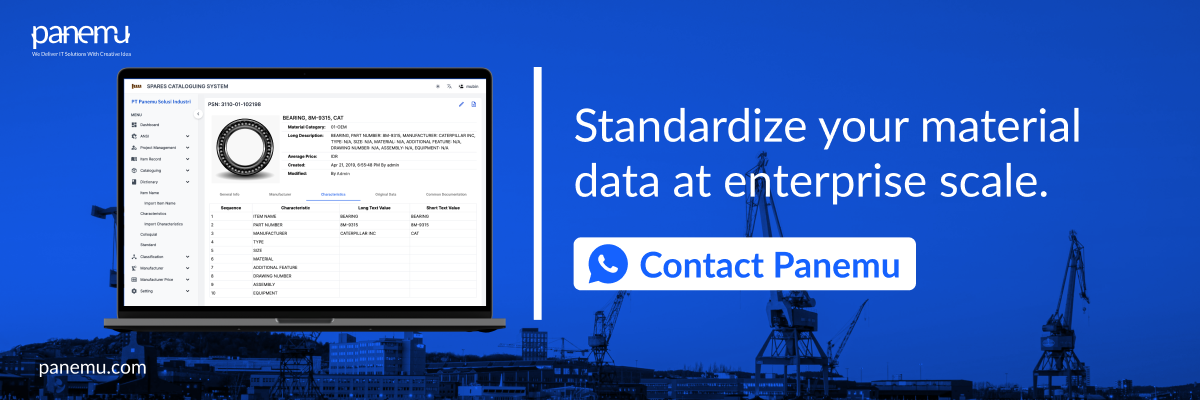
SCS® holds the authoritative version of every material master record in your group. Not a copy. Not a synchronised replica. The golden record. Every attribute — ISO 8000-compliant short description, structured long description, manufacturer part number, UNSPSC code, NATO/NSN code, criticality class, standard UoM, valuation class, equipment relationship, vendor cross-reference — lives in SCS® as the source of truth.
Each downstream ERP — your HQ S/4HANA or Oracle Cloud, your subsidiaries' Odoo or Dynamics or local platforms — receives master data from SCS® through native integration. The integration layer handles ERP-specific transformations automatically: S/4HANA wants its own material number format and view structure, Odoo expects product templates and variants, Dynamics has its own item card schema. SCS® manages these mappings so downstream ERPs receive data in the shape they need, sourced from a single consistent definition.
This is governance by architecture, not governance by policy memo. Policy memos fail. Architecture holds.
The SCS® Module Stack — What Makes the Hub Operationally Real
SCS® is engineered around six interlocking modules, each contributing to its capability as a master data hub. Let me walk through them, because the depth of the platform is what distinguishes it from generic MDM tools or integration middleware repurposed as a hub.
Intelligent Search Engine. With 200,000+ records spread across multiple tiers, finding the right material before creating a new one is the single most important duplicate-prevention behaviour. SCS®'s structured search engine handles fuzzy matching, phonetic variation, attribute-based filtering, and noun-modifier-attribute decomposition simultaneously. When a subsidiary user submits a creation request, SCS® surfaces existing canonical records across the group catalogue in seconds — preventing the duplication that drives the reconciliation tax in the first place.
Master Data Management Module. The MDM core enforces the structural discipline that consistent multi-tier operation requires. Every record is constructed against a controlled dictionary, mandatory attributes are enforced at the schema level, validation rules execute on every commit, and ISO 8000-compliant description structure is generated automatically. This is the layer that makes "the same physical part has the same canonical record" architecturally guaranteed rather than aspirationally enforced.
Normalization Engine. The normalization engine converts inconsistent legacy data — accumulated from years of independent operation across tiers — into standardised canonical form. Twelve conventions for "bearing" collapse to one structure. Unit-of-measure variations consolidate to controlled values. Manufacturer name variations consolidate to verified entities. This is the layer that converts your existing fragmented multi-tier master data into the consistent baseline that SCS® can then maintain going forward.
Duplicate Detection Module. Multi-algorithm duplicate detection — manufacturer part number matching, attribute-vector similarity, fuzzy description matching, phonetic clustering — surfaces candidate duplicates across the consolidated group catalogue with confidence scoring and clear merge rationale. This is the module that, on first deployment, identifies the 20–35% duplication that fragments your existing two-tier operation. Post-deployment, it prevents new duplicates from re-entering through the creation workflow.
Classification and Taxonomy Module. Built-in support for UNSPSC, NSN/NATO codification, internal taxonomies, and custom hierarchies — applied consistently across the entire group catalogue regardless of which tier the record originated in. This is what makes group-level spend analytics, category strategy, and procurement consolidation actually work — because the same part class means the same thing whether HQ or any subsidiary records it.
Workflow and Governance Module. Material creation requests, modification approvals, exception management, and dormancy review route through configurable workflows with role-based segregation. The hub workflow is centralised — every change, from any tier, routes through governance — while the user experience can be configured per tier to fit subsidiary operational rhythms. Every action is logged with user, timestamp, before/after values, and approver chain.
These six modules together are what makes SCS® a hub rather than a database with integration pipes bolted on. Generic MDM platforms cannot replicate this stack because they weren't architected for asset-intensive industrial master data. Integration middleware cannot replicate it because moving data is not governing data. SCS® is the only platform engineered for the exact problem your two-tier architecture creates.

Native ERP Integration — The Distribution Layer That Makes the Hub Real
A hub is only as good as its distribution. SCS® includes pre-built integration patterns and export schemas for every major ERP in the two-tier ecosystem.
Tier 1 (HQ-class): SAP S/4HANA with native material master, vendor master, equipment master, and BOM view distribution. Oracle Fusion Cloud with item master, supplier master, and asset master integration. Microsoft Dynamics 365 Finance & Supply Chain with item card and vendor master distribution. IFS Cloud, Infor CloudSuite, and other Tier-1 platforms supported through configurable integration patterns.
Tier 2 (subsidiary-class): Odoo with product template, variant, and supplier integration — particularly relevant in the Indonesian market where Odoo is widely deployed at subsidiary tier. Microsoft Dynamics Business Central. SAP Business One. Regional and local ERPs supported through SCS®'s open API layer and configurable mapping engine.
CMMS integration: IBM Maximo, SAP PM, Oracle EAM, Bentley AssetWise — so that equipment-spare linkages your reliability and maintenance teams depend on remain consistent across both the master data and the maintenance management layer.
Integration patterns support multiple modes: real-time push (changes in SCS® propagate to downstream ERPs immediately), scheduled batch (controlled distribution windows for organisations preferring change management cadence), and on-demand pull (downstream ERP requests current master state). The integration architecture is configurable to your operational and security context.
For organisations already operating an integration platform — MuleSoft, Boomi, SAP CPI, Oracle Integration Cloud, Azure Integration Services — SCS® plays well with it. The integration platform handles the pipes; SCS® handles the substance. But do not let anyone convince you that pipes alone solve a substance problem. That mistake has cost groups in our portfolio 12–24 months and millions of dollars before they came to us for the correct architectural solution.
Cross-Tier Reporting Dashboards and Data Quality Scoring
The reason ERP Directors care about master data consistency isn't technical elegance. It's that the CEO and CFO expect cross-tier reporting that holds up under scrutiny — and right now, in most groups, it doesn't.
SCS®'s reporting layer is engineered for exactly this outcome.
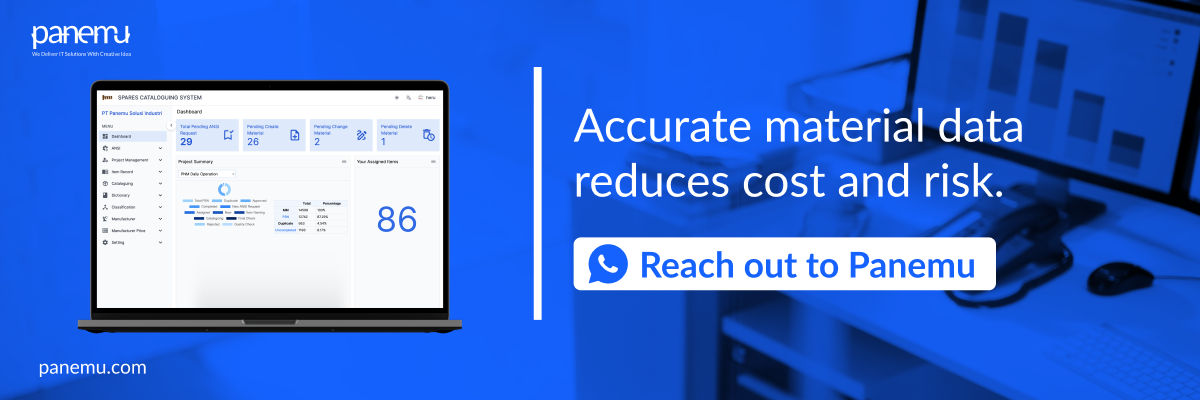
Group-level master data dashboards expose the metrics your executive team actually needs across the consolidated catalogue: total records under management, records active by tier, duplication detection status, quality score trends, governance workflow throughput, and exception resolution time. The dashboards refresh in real time, with no manual report compilation required.
Real-time data quality scoring runs continuously across the master, scoring records against the four dimensions that matter: completeness, accuracy, consistency, and timeliness. The score is broken down by tier, by category, by entity, and by time period — exposing exactly where data quality is strong and where it needs attention. For ERP Directors preparing for ESG disclosure, internal audit, or external attestation, the scoring layer produces evidence in formats designed for direct presentation.
Cross-tier spend visibility becomes possible for the first time when master data is consistent. SCS®'s analytics layer combines PO history from every ERP in the architecture against the canonical material records, producing genuinely meaningful group spend analytics. The category management conversation, the strategic sourcing prioritisation, the supplier consolidation roadmap — all of these become evidence-based rather than directionally suggestive.
Drill-down forensics. When an issue surfaces — quality dip, exception spike, integration failure — the analytics layer lets you drill from aggregate metric to specific record to specific change event to responsible user, in three clicks. The forensic capability is what converts master data governance from a managed function into an operationally credible one.
This is what SCS® delivers as default platform behaviour, not as a custom analytics build. Generic MDM tools sell the analytics layer as a premium add-on; SCS® delivers it as part of the platform because the architecture was designed with reporting as a primary outcome, not a secondary feature.
Deployment Options, Licensing, and ROI Mathematics
SCS® supports both cloud and on-premise deployment, with hybrid configurations for organisations with specific data residency, security, or corporate policy requirements.
Cloud deployment runs on enterprise-grade infrastructure with geo-redundant backup, RPO 1 hour, RTO 4 hours, encryption at rest and in transit, full audit trail aligned to ISO 27001 controls. This is the typical choice for organisations prioritising rapid deployment and managed operations.
On-premise deployment runs on your infrastructure with the same architectural capabilities — suited to organisations with regulatory constraints on cloud data residency, government and defence-adjacent contexts, or corporate policies that mandate on-premise for master data platforms.
Hybrid configurations support specific scenarios — production on-premise with DR in cloud, HQ instance on-premise with subsidiary instances in cloud, regulated entities on-premise with non-regulated entities in cloud — to fit complex group architectures.
Licensing is structured around concurrent users, data volume, and module configuration. For two-tier ERP deployments, the licensing model scales naturally as you add subsidiary spokes to the hub — making the architectural investment predictable across the M&A timeline and avoiding the per-entity licensing complexity that generic MDM platforms impose.
The ROI mathematics are compelling. A typical multi-entity group with four to six subsidiaries spends USD 800K–1.5M annually on master data reconciliation, redundant vendor management, and avoidable procurement fragmentation. SCS® hub deployment investment is recovered within 12–24 months on these recurring savings alone. Strategic sourcing consolidation enabled by consistent group master data typically adds 8–15% reduction on addressable category spend — value that can run into 8-figure annual amounts at scale. M&A integration time compression — from typical 12–18 months to 3–6 months — converts directly into earlier realisation of deal synergies.
For organisations seeking accelerated deployment combined with methodology transfer, our Cataloguing Service combines SCS® implementation with execution support to reach operational maturity in 4–6 months across multi-entity scope.
Future-Proofing for M&A — The Architecture That Survives Anything
Here's the question every ERP Director should have in their three-year planning document: what happens to your master data architecture when the group acquires a new subsidiary, or carves out an existing one for divestiture?
Without a hub, every M&A event is a master data crisis. The acquired entity arrives with its own ERP, its own coding conventions, its own catalogue of 30,000–100,000 material records overlapping unpredictably with the existing group catalogue. Integration projects run 12–18 months. Group reporting is broken for the entire integration period. Synergy targets in the deal model slip by 18+ months.
With SCS® as your hub, the M&A integration pattern is dramatically simpler. The new subsidiary's catalogue is loaded into SCS®, deduplicated against the existing group catalogue using the platform's matching engine, and reconciled within a defined timeline. The subsidiary's ERP — whatever it is — connects as a new spoke in the existing hub-and-spoke architecture. Group reporting incorporates the new entity within weeks, not quarters. Procurement consolidation begins delivering synergy in the first year, not the second.
For divestitures, the pattern is equally clean. The divested entity's master data is extracted from the hub, the spoke is disconnected, and the remaining architecture continues to operate without disruption.
This is what we mean by future-proof architecture. Your hub holds the value; your spokes are replaceable. The next ERP your HQ migrates to in 2030 plugs into the same hub. The subsidiary that gets divested in 2027 cleanly disconnects. The acquisition you haven't announced yet integrates faster than your competitors who didn't build the hub.
Claim Your Two-Tier Architecture Deep-Dive Now
Every quarter your group operates without a material master hub, you absorb the reconciliation tax (USD 400K–1.2M annually in analyst overhead), the decision tax (strategic decisions made on data leadership privately distrusts), the audit tax (recurring "lack of master data governance" findings), the M&A tax (integration timelines 12–18 months longer than they should be), and the migration tax (every future ERP project inheriting today's chaos under project pressure).
Stop paying these taxes. Architect the hub now.
Panemu offers a Two-Tier Architecture Deep-Dive for ERP Directors serious about solving this problem. The session produces a written architecture recommendation specific to your existing ERP portfolio, your subsidiary count, your integration platform, and your M&A roadmap — typically delivered within 15 business days of the discovery call. The deliverable includes:
A mapped architectural diagram showing how SCS® integrates with your specific HQ and subsidiary ERPs. A deployment option recommendation (cloud, on-premise, or hybrid) aligned to your data residency, security, and operational constraints. A licensing scope estimate for your group's user count, data volume, and module configuration. An ROI projection covering reconciliation savings, sourcing consolidation, M&A integration acceleration, and audit posture improvement. A phased deployment roadmap converting the architecture from current state to fully-operational hub-and-spoke within 6–12 months.
Deep-dive engagements are capped each quarter to protect delivery quality. ERP Directors who claim slots now will have written architecture in hand before the next budget cycle. Those who wait will continue running master data reconciliation as a recurring quarterly fire.
To explore SCS® in full — modules, integration patterns, deployment options, licensing, two-tier architecture capability — and to book your deep-dive:
👉 Discover SCS® Key Features and Book Your Two-Tier Architecture Deep-Dive
Contact our team now. The cost of waiting one more quarter is measured in reconciliation hours, distrusted reports, and M&A synergies that don't materialise. SCS® is the only platform in the region purpose-built as the material master hub your two-tier architecture requires. Book the call this week.