In asset-intensive industries such as mining, oil & gas, power generation, and manufacturing, reliability is not created on the shop floor alone. It is built long before a technician touches a tool—inside data, processes, and decisions that determine whether the right spare part is available, identifiable, and usable at the exact moment it is needed. This is where material cataloguing stops being a “data task” and becomes a strategic capability.
Panemu positions material cataloguing as a core reliability service, delivered by expert cataloguers and powered by a purpose-built platform: Spares Cataloguing System (SCS). This combination of human expertise and specialized tooling addresses the real operational problems faced by large organizations with complex MRO environments, multi-site operations, and high downtime exposure.
WHY MOST MATERIAL CATALOGUING FAILS IN PRACTICE
Many organizations are aware that their material master data is problematic. Duplicate items, unclear descriptions, missing specifications, and inconsistent classifications are common findings. However, internal cleanup initiatives often stall or fail for predictable reasons:
- Lack of dedicated cataloguing expertise
- No clear or enforced standards
- Manual processes that do not scale
- No tooling designed specifically for MRO cataloguing
- One-time cleanup without governance
As a result, material data quality improves temporarily, then degrades again. Reliability issues return. Inventory grows. Emergency procurement continues. The organization remains reactive.
Panemu was designed to break this cycle.
PANEMU’S APPROACH: MATERIAL CATALOGUING AS A RELIABILITY SERVICE
Panemu does not treat material cataloguing as simple data entry or ERP housekeeping. It is delivered as a structured service, focused on outcomes that matter to the business:
- Improved asset reliability and availability
- Reduced MTTR
- Lower MRO inventory and working capital
- Faster maintenance execution
- Trusted ERP and EAM data
This is achieved through two inseparable components:
- Expert Cataloguers with deep MRO and engineering understanding
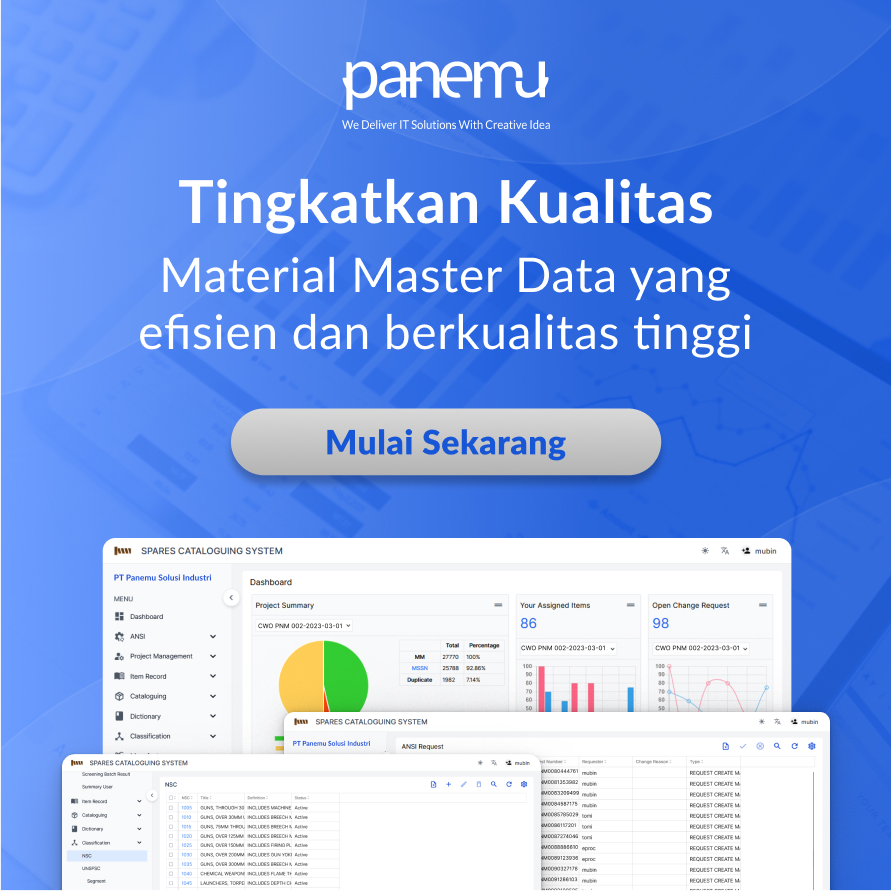
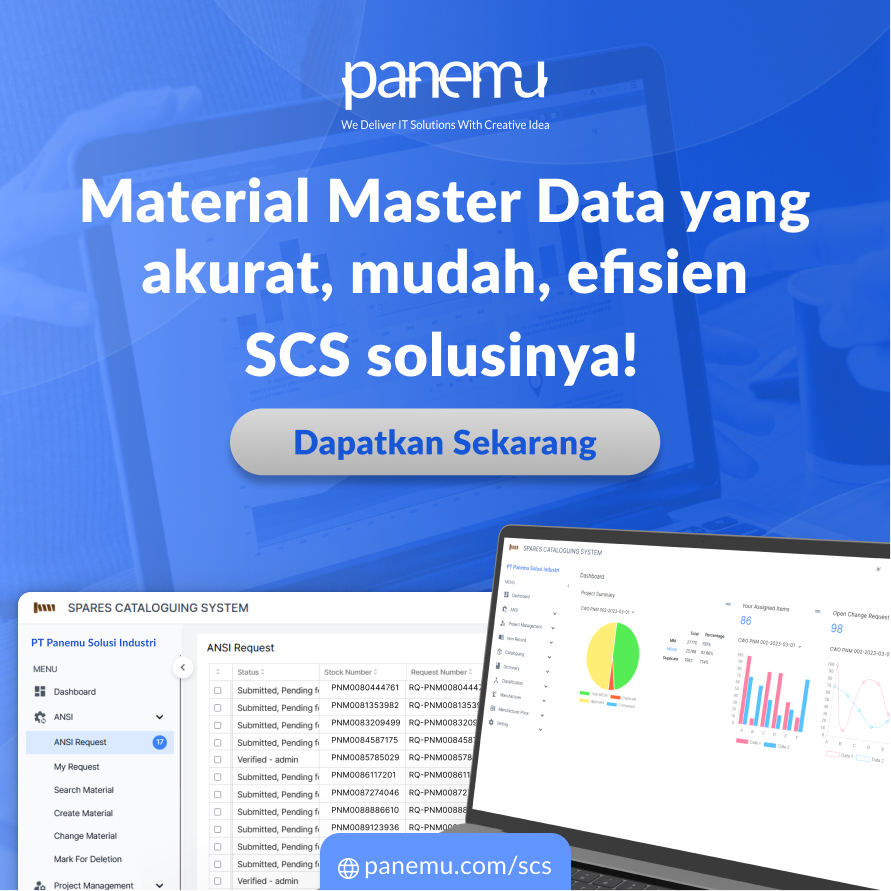
- Spares Cataloguing System (SCS), Panemu’s dedicated cataloguing platform (panemu.com/scs)
Together, they enable consistent, scalable, and governed material cataloguing in real industrial environments.
THE ROLE OF PANEMU EXPERT CATALOGUERS
At the center of Panemu’s service are expert cataloguers—not generic data administrators. These are specialists who understand:
- Mechanical, electrical, and instrumentation components
- OEM documentation and datasheets
- Interchangeability and equivalency logic
- Maintenance and supply chain use cases
- ERP material master structures
This expertise is critical. Material cataloguing is not just about “clean descriptions.” It requires engineering judgment. For example:
- Are two bearings truly interchangeable, or only dimensionally similar?
- Which technical attributes are mandatory for a centrifugal pump vs. a control valve?
- How should a spare part be classified to support maintenance search behavior?
Panemu’s cataloguers work with this level of realism, ensuring that the catalogue supports actual maintenance and procurement decisions—not just data aesthetics.
SPARES CATALOGUING SYSTEM (SCS): BUILT FOR MRO REALITY
Most ERP systems were never designed to perform large-scale material cataloguing. They store data—but they do not help structure, compare, enrich, or validate it efficiently.
This is why Panemu developed Spares Cataloguing System (SCS), a specialized platform designed specifically for MRO and spare parts cataloguing.
SCS acts as the working environment for cataloguing, sitting alongside ERP/EAM systems and enabling high-quality outcomes at scale.
Key capabilities of SCS include:
- Structured description templates by material class
- Attribute-driven cataloguing (not free text)
- Duplicate and similarity detection
- Controlled classification frameworks
- Validation workflows
- Auditability and governance support
SCS allows Panemu’s expert cataloguers to work faster, more consistently, and with far lower risk than manual or ERP-only approaches.

HOW PANEMU MATERIAL CATALOGUING WORKS — IN PRACTICE
Panemu’s material cataloguing service follows a realistic, field-proven process aligned with how large industrial organizations actually operate.
1. Discovery and Data Reality Check
The engagement starts with understanding the client’s real situation:
- Size and composition of spare part inventory
- Number of sites and warehouses
- ERP/EAM systems in use
- Current data quality issues
- Reliability and downtime pain points
Rather than attempting to “fix everything at once,” Panemu aligns scope and priorities with business impact—often starting with critical MRO materials that directly affect asset availability.
2. Cataloguing Standard Definition (Practical, Not Theoretical)
Panemu defines cataloguing standards that work in practice, not academic models. This includes:
- Structured naming logic by material type
- Mandatory and optional attributes per class
- Classification hierarchy aligned with maintenance search behavior
- Clear abbreviation and unit rules
These standards are embedded directly into SCS, ensuring consistency and preventing deviation during execution.
3. Material Cleansing and Enrichment Using SCS
Existing materials are processed through SCS, where expert cataloguers:
- Rewrite descriptions into structured, readable formats
- Validate and enrich technical attributes using datasheets and OEM references
- Apply correct classification codes
- Flag unclear or risky items for engineering review
This step transforms legacy material records into operationally usable data, not just “cleaner text.”
4. Duplicate and Interchangeability Analysis
Using SCS’s comparison and similarity features, Panemu identifies:
- Exact duplicates
- Functional duplicates
- Interchangeable or equivalent items
These findings are reviewed with engineering and supply chain stakeholders to ensure technical correctness. The result is a rationalized catalogue with fewer items, higher confidence, and better visibility.
5. ERP Alignment and Controlled Deployment
Once validated, catalogued materials are aligned with ERP or EAM structures and deployed in a controlled manner. This minimizes disruption and ensures that users experience immediate improvement—better search, clearer descriptions, and fewer errors.
6. Governance Enablement (So the Problem Does Not Return)
Panemu does not stop at cleanup. Governance is embedded through:
- Defined material creation workflows
- Use of SCS as a control layer
- Clear ownership and approval rules
- Ongoing data quality checks
This ensures that new materials follow the same standards—protecting reliability long after the initial project ends.
IMPACT ON MAINTENANCE AND ASSET RELIABILITY
For Maintenance Directors and Heads of Asset Management, Panemu’s material cataloguing delivers tangible operational results:
- Faster identification of correct spare parts
- Reduced MTTR
- Fewer maintenance delays due to wrong or missing materials
- More predictable maintenance execution
- Higher asset availability
Reliability improves not because people work harder—but because the system works better.
SUPPLY CHAIN AND INVENTORY RESULTS THAT MATTER
For Supply Chain and Procurement leaders, the benefits are equally concrete:
- Visibility into true MRO demand
- Reduction of duplicate stock
- Lower inventory value without increased risk
- Fewer emergency purchases
- Better supplier consolidation
Material cataloguing, delivered through Panemu and SCS, turns MRO inventory from a black box into a controllable asset.
MULTI-SITE OPERATIONS: ONE CATALOGUE, MANY LOCATIONS
Panemu’s approach is designed for multi-site reality. By standardizing material data across locations:
- Sites can share inventory
- Central planning becomes feasible
- Maintenance standards are aligned
- Overall spare part holdings are reduced
SCS ensures that all sites work from the same structured catalogue—without losing local operational relevance.
SUPPORTING ERP, EAM, AND DIGITAL RELIABILITY INITIATIVES
For IT and ERP Directors, Panemu material cataloguing provides a clean, structured foundation for:
- ERP reliability
- EAM effectiveness
- Reporting and analytics
- Predictive maintenance initiatives
Digital programs fail when master data is poor. Panemu ensures that material data no longer becomes the weakest link.
WHY PANEMU — AND NOT GENERIC DATA CLEANING
Panemu stands apart because:
- Material cataloguing is the core business, not a side offering
- Expert cataloguers bring engineering and MRO understanding
- SCS is purpose-built for spare parts, not generic data
- The approach is operational, scalable, and governed
This is not about “making data look better.” It is about making operations work better.
CONCLUSION: RELIABILITY YOU CAN ENGINEER, NOT HOPE FOR
In high-risk, asset-intensive industries, relying on luck is not a strategy. Asset reliability must be engineered—through systems, expertise, and data that work under real conditions.
Panemu delivers material cataloguing as a reliability capability, combining expert cataloguers with the Spares Cataloguing System (SCS) to create structured, trusted, and sustainable material master data.
Without this foundation, reliability remains fragile. With it, reliability becomes controllable.
If your organization manages large MRO inventories, operates across multiple sites, and faces high downtime costs, it is time to professionalize material cataloguing.
Consult with Panemu and explore Spares Cataloguing System (SCS) at panemu.com/scs